Table of Contents
- Neva Marshes, Spring 1703
- Peter’s Northern Vision: From Azov to the Baltic
- War and Window: The Great Northern War Context
- May 1703: The Fort on Zayachy Island
- Naming and Mapping: From Nyenschantz to Saint Petersburg
- Labor and Landscape: Building on Water and Mud
- Religion and Diplomacy: A Western Name in an Orthodox Realm
- Administration and Compulsion: Policies to Populate the City
- Merchants, Shipwrights, and the New Economy
- Saint Petersburg versus Moscow: Cultural Shock
- Sweden Responds: Military Stakes Around the Neva
- Architects, Plans, and the City’s Early Shape
- Memory, Myths, and the Date
- Legacies under the Tsars: Capital and Symbol
- Conclusion
- FAQs
- External Resource
- Internal Link
Article Summary: On 27 May 1703, amid the mud and reeds of the Neva delta, Peter I ordered the construction of the Peter and Paul Fortress, marking the foundation of Saint Petersburg. The decision fused wartime necessity with a reformer’s vision for a Baltic gateway. This article traces the military context, the forced labor and planning that followed, and the city’s rapid political ascent. It examines contested dates, names, and sources, and maps cultural tensions with Moscow. Finally, it weighs the city’s long-term legacy as Russia’s Western-facing capital.
Why keep reading: The birth of a city rarely changes a state, but this one did. Built during war, on marshland, under a tsar set on transformation, Saint Petersburg became both a strategy and a symbol—an unfinished promise about what Russia could be and a battleground over what it should leave behind.
At a glance:
- Event: Founding of Saint Petersburg through the construction of the Peter and Paul Fortress
- Date: 27 May 1703 (O.S. 16 May), with related acts earlier in May; some emphasis on the capture of Nyenschantz
- Place: Neva River delta, Zayachy (Hare) Island, near the Gulf of Finland
- Main figures: Peter I (Peter the Great), Alexander Menshikov, early architects like Domenico Trezzini; Swedish defenders of Nyenschantz
- Why it mattered: Secured a Baltic outlet, accelerated state reforms, and eventually shifted Russia’s political center of gravity from Moscow.
01 – Neva Marshes, Spring 1703
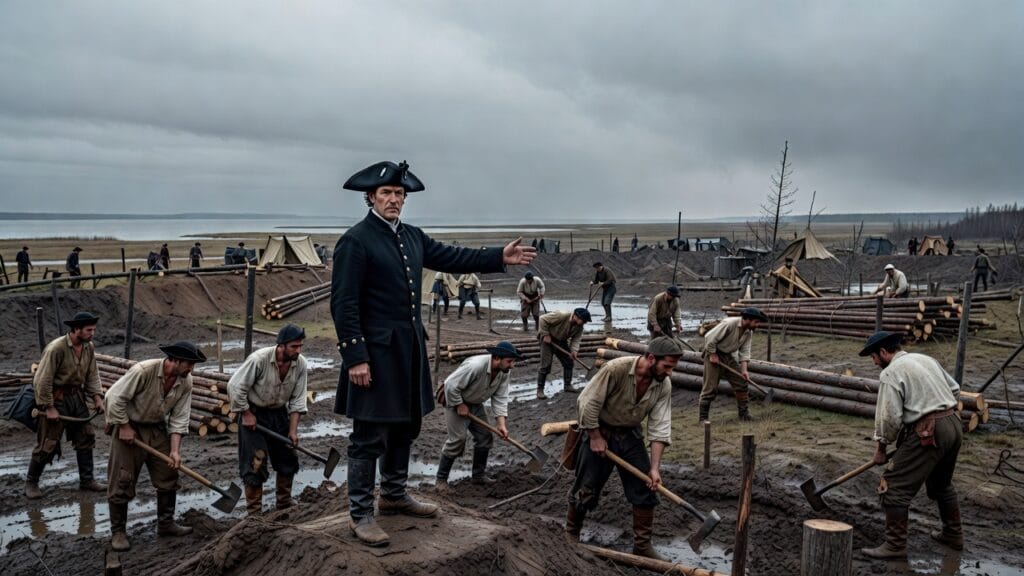
The Neva delta in spring smelled of wet earth and sap, the river pushing ice out toward the Gulf of Finland. Soldiers tramped across spongy ground, measuring, staking, and hauling timber to an island that barely rose above the waterline. Here Peter ordered a fort, and with it, the foundation of Saint Petersburg began as both a military post and a future city.
Contemporaries remembered the day as practical rather than ceremonial. The spades went in, the embankments rose, and watchfires lit the damp skies. The area had been Swedish ground a week before; now it bristled with Russian determination, ambitious, precarious, and tethered to the war that made it possible and necessary.
The fortress footprint was a statement in geometry against the soft marsh. Engineers sketched bastions with Dutch names, tsarist aides counted captives and wagons, and messengers rode out toward Lake Ladoga. Every hour had the pulse of a campaign, but also the hush of a beginning whose magnitude only slowly revealed itself.
Modern historians emphasize how provisional this start truly was. The water cut channels where it wished, disease nipped at the perimeter, and Sweden still held powerful fortresses on the Gulf. Yet Peter believed a city could be anchored here—an improbable claim that would demand policy, labor, and time.
02 – Peter’s Northern Vision: From Azov to the Baltic
Peter had chased the sea before, driving south in the 1690s to take Azov from the Ottomans, only to find the Black Sea closed by the straits. His ambitions swung north instead, where Sweden ringed the Baltic like a gate on hinges he intended to unpin. A port on deep water became both dream and strategy.
He had learned shipbuilding in Dutch yards, watched how harbors stitched states to commerce, and returned to Russia with grim impatience. If Russia were to trade on equal terms, it needed a window where winds carried Dutch, English, and German ships. The Baltic, long controlled by Sweden, offered precisely that aperture.
But ports are not conjured from maps alone. They require sovereignty, protection, pilots, and merchants willing to risk cargoes in contested waters. Peter’s northern vision demanded a war to crack Sweden’s perimeter, skilled labor to shape vessels and quays, and a political revolution to make the state serve maritime ends.
This is why the city’s founding cannot be separated from the dynamics of the Great Northern War. It was more than a building project; it was a battlefield pivot toward European trade and knowledge, undertaken at speed and under fire, with the tsar himself enforcing a schedule few dared challenge.
03 – War and Window: The Great Northern War Context
In 1700, a coalition of Russia, Denmark-Norway, and Saxony-Poland-Lithuania tested the strength of young Charles XII of Sweden. Early setbacks were brutal, including defeat at Narva. Russia endured, rebuilding and learning, absorbing pain in exchange for experience and a long-term position on the Baltic coast.
By 1702, Russian arms took Noteborg at the Neva’s source, renaming it Shlisselburg—the “key” fortress. The following spring, Russian troops encircled and captured Nyenschantz near the Neva mouth. With Sweden’s forward outpost collapsed, Peter finally had leverage at the river’s delta where fortifications, shipyards, and a future harbor could be staged.
The Neva corridor, long a contested zone, now became the hinge of both strategy and symbolism. It was still a war frontier, as Swedish garrisons held strongpoints nearby and threatened counterstrike. The new fort had to repel ships and guns while making space for something that looked less like a trench and more like a town.
04 – May 1703: The Fort on Zayachy Island
On 27 May (O.S. 16 May) 1703, Peter marked the island’s ground for the Peter and Paul Fortress. He and his circle chose a site that could command the river’s channels and deter naval approach. The foundation stones, whether symbolic or literal, were set with soldiers and prisoners straining alongside engineers.
Accounts differ on how formal the founding act appeared. Some later narratives imagine trumpets and proclamations; contemporary notes suggest practicality—wood, earth, ropes, and orders. The siege of Nyenschantz was still fresh. Artillery and manpower were precious, and the fort’s star-like geometry had to be forced onto the waterlogged landscape.
Naming the bastions after saints and Peter’s allies signaled more than piety or patronage; it declared permanence. The tsar was mapping a political will onto sandbanks. Nearby, a rudimentary dock took shape, and supplies began to reach the island, tight with rationing and braced against spring floods.
Mini timeline:
- 1700: Russia enters the Great Northern War; defeat at Narva.
- 1702: Noteborg (Shlisselburg) captured, securing the Neva’s headwaters.
- 27 May 1703: Foundation of the Peter and Paul Fortress on Zayachy Island.
- 1712: Court and government move to Saint Petersburg; 1721: Treaty of Nystad confirms gains.
05 – Naming and Mapping: From Nyenschantz to Saint Petersburg
Within weeks, documents used the Western-sounding “Sankt-Piter-Burkh,” aligning the city with a Latinized, Dutch-inflected Europe. The choice raised eyebrows in an Orthodox realm used to Slavic forms. Yet it suited Peter’s persona as a sailor-tsar and signaled the city’s intended community of reference—shipwrights, merchants, and foreign experts.
Alongside the fortress, planners traced out Vasilyevsky Island designs and an Admiralty site on the left bank. The river posed both artery and obstacle, shunting supplies unpredictably. Early sketches imagined a gridded city with long quays and canals, a geometry borrowed from the Low Countries and translated into Russian realities.
Nyenschantz’s ruin across the water offered an object lesson. Swedish lines had been strong, but the fortress could be starved and stormed when isolated. The new city would rely on mobility: riverboats, winter sledges, and, soon, a harbor shielded by a new outpost at Kotlin Island—Kronstadt—to block hostile fleets.
The foundation of Saint Petersburg therefore emerged from names and lines as much as stones. A perceptible shift occurred from simply holding ground to composing an urban space. This reimagining was political and cultural, not only tactical—a declaration of intent to build a Europeanized capital within a Russian war zone.
06 – Labor and Landscape: Building on Water and Mud
Workers hacked at willow roots, sank piles into mud, and carried baskets of earth on their backs. They were soldiers, conscripted peasants, and Swedish prisoners lashed into a single laboring mass. Water undermined embankments with patient malice, and each thaw reworked the job already done.
Housing was a crisis. Huts rose quickly, roofs leaked, and fires threatened lines of stores. Food arrived erratically, and disease thrived in damp quarters where men slept in shifts. The project’s speed made errors inevitable; the climate exposed them relentlessly, forcing repair, redesign, and a grim acceptance of loss.
Menshikov oversaw much of the early provisioning and coercion, his name tied to both triumphs and abuses. The city was a command economy before it became a marketplace. The unpredictability of the delta meant improvisation—boats sank, masts splintered, timber warped—and each failure burdened the workforce.
07 – Religion and Diplomacy: A Western Name in an Orthodox Realm
Peter named the city for his patron saint and chose a cathedral that would pierce the sky with a spire rather than a traditional dome. The Peter and Paul Cathedral projected power upward, aligning visual language with a broader Western turn. It also anchored authority within an Orthodox sacred space.
The city’s liturgical life adapted. Clergy followed the construction caravans, blessing foundations and interceding with the sick. Yet the public message emphasized state over shrine, with ceremonies carefully staged to consolidate war gains into civic pride. The cathedral’s rising silhouette advertised continuity, even as customs and calendars edged westward.
Diplomatically, the city’s name spoke volumes to foreign courts. Envoys read in it a comfort with European forms, welcoming signals for trade treaties and technical missions. The tsar’s choice, while unsettling to some at home, reassured merchants in London, Amsterdam, and Hamburg that Russia would meet them in familiar civic attire.
This was not a wholesale rejection of Muscovite piety, but a recalibration of emphasis. Peter selectively composed the city’s imagery to carry both Orthodox blessing and maritime ambition. The new capital would bow before saints and state alike, with the latter pulling steadily at the former’s sleeves.
08 – Administration and Compulsion: Policies to Populate the City
Urban policy followed the shovel. Peter issued ukases directing nobles, officials, and skilled craftsmen to settle on the Neva. The orders threatened fines and career stagnation for those who lingered in Moscow. Stone masons were particularly prized; the famous decree banning stone construction elsewhere in 1714 was designed to feed Petersburg’s appetite.
Records in the Complete Collection of the Laws of the Russian Empire preserve the administrative scaffolding: tax breaks, plot assignments, and regulated building lines. The city’s police administration grew quickly, tasked with fire prevention, market inspection, and managing foreign artisans who were both needed and suspiciously watched.
Compulsion was tempered by incentives. Merchants received monopolies and reduced duties to reroute trade through the Baltic. Foreign shipwrights had wage privileges; craftsmen received plots near their yards. Yet the tone remained unmistakably coercive, and the city’s early social fabric bore the creases of a plan imposed from above.
The foundation of Saint Petersburg thus hinged on law as much as labor. Administrative pressure transformed a military foothold into a population center. Without the weight of decrees, the marsh would likely have reclaimed its edges; with them, a reluctant aristocracy and a motley working class found themselves entangled in a new civic experiment.
09 – Merchants, Shipwrights, and the New Economy
Trade altered its routes slowly, then decisively. In the early years, convoys threaded dangerous coasts, protected by a navy still learning the sea it hoped to master. Wharves at the Admiralty sprouted cranes and warehouses, and a customhouse tracked cargoes of hemp, timber, tar, furs, and imported tools to feed the war engine.
Kronstadt on Kotlin Island became the city’s shield and lock. Its harbor offered anchorage beyond the worst Neva shoals, and batteries ensured Swedish sails kept their distance. Shipyards built and repaired vessels at furious pace, while inshore workshops shaped masts and rope. An economy of maritime necessity became a commercial habit.
Foreign experts formed a volatile but productive enclave. Dutch and English merchants negotiated privileges; German craftsmen filled technical gaps. Prices ran high, supply chains kinked, and fraud thrived in confusion. Yet profits glinted through. The city’s entrepreneurial pulse strengthened, even as winter ice jailed ships and spring floods tested harbor works.
10 – Saint Petersburg versus Moscow: Cultural Shock
The relocation of court and Senate in 1712 signaled that the Neva city would not remain a frontier. For Muscovites steeped in Kremlin rhythms, Petersburg felt alien—streets aligned to water, avenues straight and wind-scoured, fashions trimmed short, and beards taxed. The old capital became a memory palace; the new one was a workshop.
Resistance flickered in jokes, delays, and quiet refusals. Some nobles built token houses and fled back to familiar estates, stretching the law. Others surrendered to necessity, learning to navigate salons, embassies, and shipyards. The city’s newness allowed unusual social intersections, even as rank still governed invitations and careers.
Etiquette became policy. Western dress codes at court, enforced lessons in navigation and mathematics, and sponsorship of theaters and scientific assemblies inflected aristocratic routines. Peter’s aim was to forge a service nobility at home in charts, not merely genealogies. The city enforced this lesson in its buildings, offices, and daily traffic.
The foundation of Saint Petersburg therefore did cultural work as forcefully as any edict. It trained eyes toward the sea and minds toward mobility. The shock did not dissolve tradition, but it rearranged priorities, replacing the icon corner of Muscovite identity with a window—literally—looking west over gray water.
11 – Sweden Responds: Military Stakes Around the Neva
Swedish forces did not simply accept the new Russian presence. Charles XII campaigned deep into Poland-Lithuania and Ukraine, seeking to break the coalition’s spine. This strategy, however, pulled pressure away from the Baltic shore, buying Peter the time needed to thicken Petersburg’s defenses and grow a navy from contention to competence.
Key operations secured the region: the capture of Vyborg in 1710 tightened control over approaches, while the founding of Kronstadt plugged the gulf’s inner gate. Swedish raids and blockades still frightened merchants, but fortress lines, gunboats, and a learning officer corps steadily improved the Russian position.
Poltava in 1709 altered the war’s tempo. Sweden’s defeat there did not end the conflict, but it sapped offensive energy, making this an era when Petersburg could consolidate. Timber shipments increased, stone quays extended, and the city’s garrison drilled to patterns that impressed foreign observers accustomed to older Russian regiments.
When peace finally came with Nystad in 1721, much of the victory had already been built into the soil and piles of the city. The treaty confirmed what the fort had asserted in 1703: the Neva delta would be Russian, and from it would flow a maritime policy that shaped the eighteenth century.
12 – Architects, Plans, and the City’s Early Shape
Domenico Trezzini, a Swiss-Italian architect, translated Peter’s will into street lines and facades. Baroque elements were domesticated to local materials, giving rise to a distinct Petrine style—severe but rhythmic, practical yet ornamented at key nodes. Bastions, barracks, and palaces learned to share the same skyline.
Jean-Baptiste Le Blond proposed grander vistas, with axial prospects and fountains, some too ambitious for the marsh’s stubbornness. Nonetheless, their drafts seeded future plans, and the city took on a disciplined geometry. Canals organized movement, warehouses squared to the water, and churches punctuated neighborhoods with spires rather than onion domes.
Peter’s own “cabin” made of timber, preserved and encased, became a shrine to modest beginnings. It was less a relic than an argument: great things could start small, provided will and work kept shape. The city’s administrative heart at the Admiralty grew around this ethos, mixing shipbuilding with governance and instruction.
As stone replaced log, the city’s stature changed in foreign eyes. Embassies asked for plots, merchants for wharf space, and officials for reliable addresses. Maps became both tools and propaganda, spreading the impression of inevitability. The city that began as a fort increasingly looked like a capital.
13 – Memory, Myths, and the Date
Which moment counts as the founding? The capture of Nyenschantz opened the delta; the laying of the Peter and Paul Fortress declared the city. Later chroniclers preferred the clarity of a single day, 27 May 1703, but contemporary documents show a process, not an instant. The calendar shift between old and new styles adds another wrinkle.
Newspapers and sermons elevated the date into a civic birthday. Over time, the foundation of Saint Petersburg became a ritual memory, celebrated against the river’s seasonal moods. Yet historians caution against tidy origin stories. Cities emerge from sequences—campaigns, edicts, shipments, and drafts—stitched together by people and need.
The archive is candid about gaps. Vedomosti mentions construction in passing; diplomatic reports focus on military positions; fiscal records prioritize tax flows. From these fragments, a credible picture forms: the fort’s establishment in late May marks the decisive pivot when intent became architecture and settlement gained a center.
It is easy to forget how fragile this world still was. Spring ice could rip moorings; a delayed convoy could starve a quarter. The triumph of a fixed founding date coexists with the contingency that followed it, reminding us that even the most monumental beginnings were provisional in their own time.
14 – Legacies under the Tsars: Capital and Symbol
By 1712, court and government offices operated from the Neva. The city’s ceremonial life grew with it—naval reviews, civic processions, and diplomatic receptions signaling a state confident enough to stage itself on European shores. The imperial proclamation of 1721 only confirmed what the river had already advertised: Russia’s gaze had turned seaward.
Through the eighteenth and nineteenth centuries, Petersburg became a workshop of administration and art. Academies trained cartographers, engineers, and physicians; theaters and salons shaped taste. The capital’s openness to Europe did not dissolve its Russianness but blended influences into a distinctive civic culture, often at odds with provincial rhythms.
Crisis punctuated grandeur. Floods periodically bruised avenues, reminding residents that water never fully yielded. Political crises—from palace coups to Decembrist revolt—played out on the city’s squares, linking power to place. The city was an instrument with a timbre of its own, sometimes amplifying authority, sometimes distorting it.
The foundation of Saint Petersburg thus began a centuries-long argument about Russian identity. Renamed Petrograd in 1914 and later Leningrad, the city absorbed layers of meaning while keeping its original argument visible in stone, water, and streetlines: that a capital could be engineered toward the horizon of Europe and still speak Russian.
Immediate consequence:
Securing the Neva delta created a fortified supply base, a nascent port, and a seat for wartime administration—all of which tightened Russia’s hold on the Baltic.
Long-term consequence:
The city reshaped governance, economy, and culture, becoming an enduring capital and symbol of Russia’s European engagement far beyond Peter’s reign.
15 – Conclusion
At its core, the founding of Saint Petersburg was an act of war that became an act of statecraft. In the delta’s mud, Peter inscribed a policy that fused seapower with reform, coercion with opportunity, and the grammar of European cities with the vocabulary of Russian rule.
The foundation of Saint Petersburg did not resolve Russia’s contradictions; it organized them into a capital. From fortress to empire, from marsh to metropolis, the city’s beginning remains a study in how geography, ambition, and law can build a new center of gravity—and ask a nation to orbit it.
16 – FAQs
- When was Saint Petersburg founded?
The commonly accepted date is 27 May 1703 (Old Style 16 May), when construction began on the Peter and Paul Fortress. Some accounts also stress the earlier capture of Nyenschantz as part of the founding sequence. - Where exactly did the foundation take place?
On Zayachy (Hare) Island in the Neva delta, near the Gulf of Finland. The site controlled key river channels and could anchor defenses against Swedish naval approaches. - Who were the main figures involved?
Peter I (Peter the Great) led the project, supported by Alexander Menshikov. Early architectural direction came from Domenico Trezzini. Swedish commanders at Nyenschantz shaped the military context that made the site available. - Why did Peter found the city there?
To secure a Baltic outlet for trade and war. The Neva delta offered strategic control of waterways, proximity to sea lanes, and a platform to project a Western-facing identity through architecture, administration, and commerce. - What were the immediate consequences?
A fortified base, shipyards, and a redirected flow of goods and officials. The city’s establishment solidified Russia’s wartime gains and accelerated state reforms, culminating in its designation as capital in 1712. - What is the legacy of the foundation of Saint Petersburg?
The foundation of Saint Petersburg recast Russia’s political and cultural center. It drew the court, bureaucracy, and trade toward the Baltic, embedding European connections while writing a new chapter in Russian urban and imperial history.
17 – External Resource
18 – Internal Link
Other Resources
- Encyclopaedia Britannica – general search for the exact subject
- Google Scholar – academic search for the exact subject
- Internet Archive – digital library search for the exact subject
Sources and References
-
Peter the Great, Ukaz on the Founding of Saint Petersburg (27 May 1703).
Primary source. The imperial decree by Tsar Peter I ordering the construction of a fortress and new city on the Neva delta. This document underpins the stated founding date of Saint Petersburg (27 May 1703, Old Style) and supports details about Peter’s direct role in selecting the site and initiating construction during the Great Northern War. -
Собрание государственных грамот и договоров (Collected State Charters and Treaties), vol. 6, Russian Academy of Sciences, Saint Petersburg, 1820s.
Primary source compilation. A nineteenth‑century edition of earlier charters, ukazy, and diplomatic acts relating to the reign of Peter I and the Great Northern War. Frequently cited for the legal and administrative acts surrounding the early years of Saint Petersburg, including land allocation, fortification orders, and the city’s early status within the Tsardom of Russia. -
Hughes, Lindsey. Peter the Great: A Biography. New Haven and London: Yale University Press, 2002.
Modern scholarly monograph. A detailed academic biography of Peter I that contextualizes the founding of Saint Petersburg within his broader program of state reform and Westernization. Supports discussion of Peter’s strategic motives (access to the Baltic, a “window to Europe”), the military context of the Great Northern War, and the political implications for the Tsardom of Russia. -
Bushkovitch, Paul. Peter the Great: The Struggle for Power, 1671–1725. Cambridge: Cambridge University Press, 2001.
Modern scholarly monograph. Focuses on political power, court dynamics, and state-building under Peter I. Used for analysis of how founding a new capital on the Neva altered the balance between traditional Muscovite elites and the emerging Petrine bureaucracy, and for the broader description of Petrine reforms affecting the Tsardom’s governance. -
“Saint Petersburg.” Encyclopaedia Britannica, online edition, Encyclopaedia Britannica, Inc.
Reference encyclopedia. Provides a concise, peer‑reviewed overview of the city’s foundation date, geographic setting on the Neva River and Gulf of Finland, subsequent elevation as imperial capital, and later historical developments. Used to confirm basic chronological facts and geographic descriptions related to the city’s origin in 1703. -
Wortman, Richard. Scenarios of Power: Myth and Ceremony in Russian Monarchy, Vol. 1. Princeton: Princeton University Press, 1995.
Modern academic study. Examines imperial symbolism and public representation under the Russian monarchy. Cited for interpretation of Saint Petersburg as a consciously “European” showcase city and for the role of its architecture, urban planning, and ceremonial spaces in expressing the new identity of the Tsardom/Russian Empire under Peter and his successors. -
“The Founding of St. Petersburg.” Peter the Great Museum of Anthropology and Ethnography (Kunstkamera), Russian Academy of Sciences, Saint Petersburg.
Museum/academic institution resource. An institutional overview based on archival materials and artifacts held in Saint Petersburg. Used to corroborate details of the early urban development of the city, the conditions of construction, and the involvement of foreign specialists and Russian labor during the first decades after 1703. -
Massie, Robert K. Peter the Great: His Life and World. New York: Alfred A. Knopf, 1980.
Well‑researched historical synthesis. A widely cited narrative history drawing on Russian and Western primary sources. Provides additional context for the foundation of Saint Petersburg during the Great Northern War, including descriptions of the swampy terrain of the Neva delta, the building of the Peter and Paul Fortress, and the hardships experienced by workers and soldiers involved in the city’s construction.

