Table of Contents
- Britain at the Turn of the Century
- The June Crisis: Appendicitis and Delay
- Recasting the Ceremony: Abbey and Ritual
- London on Parade: Routes, Crowds, Policing
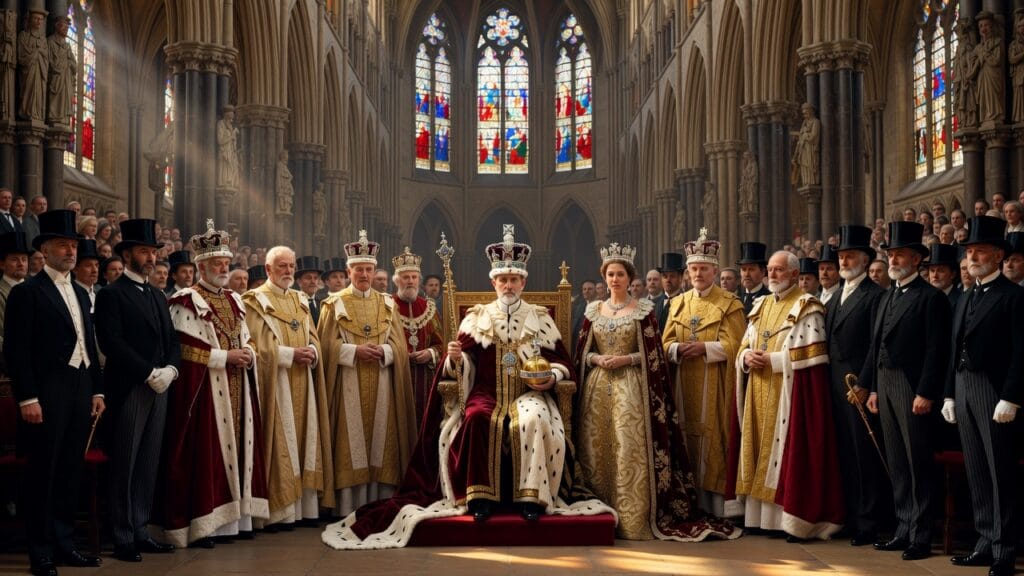
- Inside the Abbey: Oath, Anointing, Crowning
- Queen Alexandra’s Coronation
- Empire on Display: Delegations and Meanings
- Sound, Music, and the New Media
- Street-Level Realities: Commerce, Charity, Strain
- Politics and Constitution in 1902
- Faith, Myth, and the Monarchy’s Image
- What Followed: Honors, Durbar, and Memory
- Legacies of the Edwardian Beginning
- Conclusion
- FAQs
- External Resource
- Internal Link
Article Summary: The coronation of King Edward VII on 9 August 1902 arrived late and fragile, postponed by a sudden operation that shocked an empire. When the moment finally came, London turned itself into a living stage where ritual, power, and technology intertwined. This article reconstructs the day, the months around it, and the meanings attached to a new reign. It follows the survivors of war, the hopes of reformers, and the anxieties of a monarchy adapting to mass politics. Using contemporary reportage and later analyses, it traces how an old rite became a modern spectacle. It argues that the event’s resonance reached from Westminster’s altar to the furthest colonial port.
Why keep reading: Because behind the trumpets lay a nation just out of war, a king who almost died, and a ceremony forced to prove that monarchy could still bind a sprawling, contested empire. The stakes were legitimacy, unity, and a new public language of spectacle.
At a glance:
- Event: Coronation of King Edward VII and Queen Alexandra
- Date: 1902-08-09 (postponed from 1902-06-26 due to illness)
- Place: Westminster Abbey, London, United Kingdom
- Main figures: King Edward VII; Queen Alexandra; Archbishop of Canterbury Frederick Temple; Prime Minister Arthur Balfour
- Why it mattered: It inaugurated the Edwardian era, presented imperial unity after the Boer War, and reshaped royal ritual for a mass-media age.
01 – Britain at the Turn of the Century
The summer of 1902 found Britain poised between late-Victorian habit and Edwardian possibility. Queen Victoria’s death the previous year had closed a symbolic age, and the nation now watched her son, long the Prince of Wales, prepare to wear the crown. The public craved renewal, yet continuity remained the language of power.
The empire had just weathered the South African War’s bitter end, signed in May. Soldiers returned, some limping, while newspapers debated lessons in logistics, command, and cost. London itself was changing fast, its streets increasingly wired with telegraphs, its crowds governed by new police routines, and its spectacles commercialized through tickets and souvenir programs.
Edward, sixty by 1902, was no boy-king but an experienced public figure whose social diplomacy had shaped European courts for decades. As monarch he would now play host not only to peers and bishops, but to politicians attuned to the electorate, and to an imperial personnel that spanned continents and languages.
02 – The June Crisis: Appendicitis and Delay
The first date set for the coronation was 26 June 1902, and London had already erected stands, hung flags, and prepared feasts. Then, two days before, the nation learned the king faced an emergency operation for appendicitis, described in the language of the time as perityphlitis. The postponement felt like an intake of breath across the empire.
Sir Frederick Treves performed the surgery and, in concert with modern antiseptic practice, drained the abscess. The king’s convalescence became a public narrative, austere and closely watched. Newspapers carried official bulletins, and street rumor moved faster than print, blending concern with an emerging respect for surgical science and royal candor.
Planners dismantled the late-June apparatus with haste that cost money and pride. Hotels refunded bookings, caterers wrote off food, and volunteers shifted charity meals to different days. The pause magnified the stakes of August, turning a routine, if grand, rite into a measured recovery story the monarchy had to perform convincingly.
03 – Recasting the Ceremony: Abbey and Ritual
Postponement forced ritualists, clergy, and officials to regroup. Westminster Abbey’s nave, already draped and scaffolded, waited weeks longer than intended, a vast stage managed by ecclesiastical hands schooled in precision. The order of service, rooted in the 1689 and 1838 precedents, would proceed with conservative gravity, but small adjustments reflected the realities of 1902.
Archbishop of Canterbury Frederick Temple, elderly and formidable, prepared to lead the rite with the Archbishop of York, William Maclagan, assisting. The liturgy held its spine: recognition, oath, anointing, investiture, and crowning. Yet the re-timing changed the emotional register; where June had promised exuberance, August carried a steadier pulse, like someone recovering strength after illness.
Logistically, the Abbey’s seating plans were a puzzle of precedence. Peers and peeresses, foreign envoys, colonial and dominion representatives, military officers, and civic dignitaries all had places governed by centuries of rank. The shuffled date meant reissued tickets and reprimands to scalpers, while the Abbey’s vergers rehearsed routes until they could walk them by memory in the dark.
04 – London on Parade: Routes, Crowds, Policing
Outside the Abbey, London became choreography. The streets along the royal routes were dressed with arches, bunting, and rented seating, much of it rebuilt after June’s disappointment. Policing, planned by Scotland Yard, balanced crowd control with a softer aim: let people see something that felt theirs, not merely the property of the titled and ticketed.
Vendors sold flags and pins; photographers hawked vantage spots on rooftops; children watched the rehearsed movements of troops with more awe than comprehension. The city’s memory of Jubilee parades from the 1890s helped organizers anticipate where the throngs would swell. August weather offered a mercy of light breezes and intermittent sun, favorable to long hours outside.
Mini timeline:
- 1901-01-22: Queen Victoria dies; Edward accedes.
- 1902-06-24: Emergency operation postpones June coronation.
- 1902-08-09: Coronation in Westminster Abbey.
- 1902-08-16: Naval Review at Spithead marks imperial sea power.
Telegraph offices along the route prepared for surges as correspondents filed dispatches minute by minute. The spectacle, though locally rooted, unfolded for an audience far beyond London. Canadians, Australians, Indians, South Africans, and New Zealanders tracked bulletins that made the capital’s streets their own theater, at least for a day.
05 – Inside the Abbey: Oath, Anointing, Crowning
When the Abbey doors closed and the procession’s thunder grew muffled, the rite’s ancient heart beat. The recognition bound people and monarch in a formal exchange, followed by the coronation oath, which committed Edward to govern according to law and to maintain the established Protestant religion. The words were old, their constitutional resonance thoroughly modern.
The anointing, veiled from most eyes by a canopy, remained the ceremony’s theological core. Oil touched head, breast, and hands, sanctifying not merely a ruler but a vocation. Investiture followed: spurs and sword, armills and orb, scepter and rod. Then, with grave weight, St Edward’s Crown descended, a moment at once intimate and imperial.
Contemporary sources suggest the king, not fully recovered, paced himself carefully. After homage by peers, he exchanged heavy regalia for lighter state insignia. On departure he wore the Imperial State Crown, glittering with a condensed kind of authority, the Abbey’s stones echoing with anthem and tread as the procession reassembled for London’s open air.
06 – Queen Alexandra’s Coronation
Queen Alexandra’s coronation, held within the same service, threaded devotion and diplomacy. As consort, she embodied continuity and soft power, linking Britain to Denmark and to a web of European royals shaped by intermarriage and etiquette. Her presence steadied an audience alert to the king’s recent convalescence, offering grace where his role demanded gravity.
A new crown made for Alexandra featured the Koh-i-Noor diamond, re-cut in the nineteenth century and long entwined with imperial narratives. The gem’s prominence gestured toward India’s central place in the imperial imagination while reminding observers of the politics that accompanied luxury. Jewel and ritual fused in a carefully staged allegory of dominion.
The queen’s kindnesses—publicly visible through hospital patronage and a famed personal warmth—gave the ceremony an accessible face. In an era before televised intimacy, gestures counted: a glance, a steady carriage, a small smile recognized by distant onlookers. Tradition remembers her as a figure who made splendor somehow human without diminishing its force.
07 – Empire on Display: Delegations and Meanings
The coronation assembled the empire in miniature. Colonial premiers and dominion representatives attended in numbers that spoke less of uniform opinion than of negotiated loyalty. Some had arrived earlier for the Colonial Conference of 1902, where policy differences surfaced even as ceremonial unity filled photographs and official programs.
Indian princes, African administrators, Australasian politicians, and Canadian dignitaries stood within a single architectural embrace, their varied dress a textured map of power’s reach. Yet behind the embroidery lay recent memory of the Boer War’s brutal camps and guerrilla warfare. Unity needed spectacle to hold, but spectacle alone could not decide legitimacy’s harder questions.
Modern historians debate how far the day smoothed over those fractures. The surviving evidence points toward a careful balancing act: honors and precedence for colonial elites, guarantees of visibility, and moments designed to make the distant feel present. The empire appeared as a family photo taken in perfect light, a portrait concealing as much as it revealed.
08 – Sound, Music, and the New Media
Music made the Abbey breathe. Handel’s Zadok the Priest, long embedded in coronation tradition, lifted the recognition into something resembling timelessness. Hubert Parry’s I was glad, composed for 1902 with the “Vivats” of Westminster School woven in, gave the procession an energy both scholastic and exultant, a chorus of youth echoing ancient forms.
Outside, bands threaded military precision with popular taste. Elgar’s recent march, christened by audiences with words that hardened into near-hymn, found life in concerts and streets, even if the Abbey’s formal program guarded its own canon. The Master of the King’s Musick, Sir Walter Parratt, oversaw a machine of sound that disciplined emotion into ceremony.
New media stitched the metropolis to the empire. Telegraph lines and cable traffic moved summaries across oceans with astonishing speed. Short film reels toured music halls within days, recasting royal ritual as a commodity of modern entertainment. The coronation of King Edward VII, therefore, lived twice: once as sacred rite, and again as reproducible spectacle.
09 – Street-Level Realities: Commerce, Charity, Strain
In June, postponement had punished small traders who had stocked perishable goods and rented stands. August brought partial redemption but not full recovery. Tailors, confectioners, and printers rode the renewed demand; hoteliers learned the risks of overconfidence in a city where even a monarch’s illness could reroute capital. Spectacle’s economy always had winners and losers.
Charity dinners for the poor, planned to coincide with the original date, had sparked a wave of donations and logistics later tangled by postponement. Many were rescheduled, but not all supplies survived. Still, August saw renewed efforts—parish halls serving thousands, hospitals receiving special grants—subtly aligning royal celebration with social care in an era awakened to reformist rhetoric.
Policing remained mostly calm, with only scattered injuries as crowds surged to glimpse the gilded carriages. The emotional pitch rarely slipped into disorder, sustained by a felt need to turn relief into celebration. The day’s quiet labor—cleaners, drivers, cooks—made the pageant’s upper tiers look effortless. It is easy to forget how fragile this world still was.
10 – Politics and Constitution in 1902
Politically, Britain had shifted in the weeks before the ceremony. Lord Salisbury resigned in July, and Arthur Balfour became Prime Minister, bringing an intellectual air to a Conservative government contending with the costs of war and the complexity of empire. The coronation, therefore, greeted not only a king but a cabinet calibrating its authority.
Constitutionally, the oath mattered. The language tied royal power to law, Parliament, and the Protestant settlement, signaling continuity in a period of reformist murmur. The ritual’s insistence that sovereignty lived within constraints soothed a press inclined to measure every gesture for signs of royal overreach or political partisanship.
Joseph Chamberlain, still Colonial Secretary, moved through the day as both architect and lightning rod. His vision of imperial preference and tighter bonds met quiet skepticism among some dominion delegates. The victory solved one problem and created another: military conflict had ended; economic and political arguments began in earnest.
11 – Faith, Myth, and the Monarchy’s Image
Ritualized monarchy did more than enthrone; it sanctified a political imagination. Anointing with oil, the language of covenant, and the visual grammar of scepter, orb, and sword wove divine right’s echo into constitutional modernity. Few believed in medieval absolutism, but many valued the symbolism of consecrated service as a moral frame for authority.
There was also mythwork at play: the nation as a choir, the empire as a family, the crown as mediator between dignity and popular emotion. Modern historians remain cautious because the surviving record is fragmentary at the level of private feeling. Yet editorial columns and sermons reflect a hunger for unity that ceremony could momentarily feed.
For Edward, famous in youth for sociability and at times scandal, the Abbey offered a reset. Cloaked in centuries, he stood as a figure of steadiness after illness and war. Image, however, demanded maintenance—public engagements, hospital patronage, military reviews—each appearance reinforcing the story the coronation wrote in light and stone.
12 – What Followed: Honors, Durbar, and Memory
After the Abbey came the administrative thunder of honors: peerages, knighthoods, and decorations moving through the London Gazette with formal cadence. Such lists were not mere vanity; they were instruments of policy, binding service to recognition and distributing symbolic capital across a layered society. Recipients carried their titles into local memory and national networks.
A week later, the Naval Review at Spithead dramatized sea power. Warships lined the Solent, sending a message to friend and rival alike that maritime supremacy remained Britain’s nervous system. Abroad, plans unfurled for the 1903 Delhi Durbar, which would stage the imperial title “Emperor of India” with a pageantry impossible to reproduce in Westminster.
The coronation’s memory lodged quickly in albums, scrapbooks, and film reels. Souvenir china appeared in suburban parlors; order-of-service booklets rested in drawers next to wedding certificates and baptismal records. The coronation of King Edward VII thus became domestic history as much as state spectacle, a shared reference point for neighbors and strangers alike.
13 – Legacies of the Edwardian Beginning
What did August 1902 change? It launched the Edwardian era with confidence shaded by caution. The monarchy showed it could speak a modern language—media-savvy, emotionally fluent, constitutionally circumspect—without abandoning the sacred grammar of anointing and crown. At the same time, it concealed colonial fractures and social inequities that would demand more than pageantry to mend.
Economically, the spectacle previewed a twentieth-century marketplace of ceremony. From licensed images to grandstand tickets, the royal day circulated as product. Culturally, it rehearsed a politics of belonging, where millions could feel part of a common story. But this was only the beginning, as debates on tariff reform, welfare, and Irish Home Rule pressed in.
Internationally, the event signaled a regime adept at soft power. Observers abroad noted the orderly blend of tradition and modernity, while British diplomats leveraged the moment to reassure allies and court undecided publics. Over time, the coronation’s grammar influenced how later reigns—George V in 1911, Elizabeth II in 1953—staged sovereignty for mass audiences.
Immediate consequence:
Renewed confidence after war and illness; a political reset under Balfour; and a public sense that monarchy could bridge classes and distances through carefully managed ceremony.
Long-term consequence:
A template for twentieth-century royal media strategy, a strengthening of imperial symbolism before its eventual unraveling, and an Edwardian cultural mood that prized spectacle alongside reform.
14 – Conclusion
Across a single August day, the crown proved itself elastic. The coronation of King Edward VII gathered the Abbey’s sacred hush, the city’s restless crowds, and the empire’s far horizons into one performance of continuity after crisis. It suggested a monarchy fluent in modern publicity yet anchored in rites older than Parliament’s stones.
The event’s deeper meaning lies in that balance. By pairing vulnerability—the king’s illness, a nation’s weariness after war—with ceremonial assurance, 1902 taught the crown how to survive twentieth-century scrutiny. Its legacy endured not as a fossil but as a living script, revised by each reign yet recognizable, binding sovereignty to service in a changing world.
15 – FAQs
- When did the coronation take place?
It occurred on 9 August 1902, postponed from 26 June after the king underwent emergency surgery for appendicitis. - Where was the ceremony held?
At Westminster Abbey in London, the traditional site for English and later British coronations since the eleventh century. - Who were the main figures?
King Edward VII and Queen Alexandra were crowned, with Archbishop of Canterbury Frederick Temple presiding and Arthur Balfour newly serving as Prime Minister. - What caused the delay?
Two days before the original date, the king required surgery described as perityphlitis. Sir Frederick Treves operated, and recovery pushed the ceremony into August. - What were the key consequences?
Immediately, it restored public confidence after the Boer War and a health scare. Longer term, it set a template for royal media engagement and imperial pageantry later echoed by subsequent coronations. - Why does the event matter today?
The coronation of King Edward VII showed how monarchy could adapt to mass politics and emerging media, shaping how modern Britain stages sovereignty and how audiences worldwide experience royal ritual.
16 – External Resource
17 – Internal Link
Other Resources
- Encyclopaedia Britannica – general search for the exact subject
- Google Scholar – academic search for the exact subject
- Internet Archive – digital library search for the exact subject
Sources and References
1. The Times (London). “The Coronation of King Edward VII and Queen Alexandra.” 9–11 August 1902. Contemporary newspaper reports.
Note: Provides primary eyewitness coverage of the coronation ceremony at Westminster Abbey, the procession routes through London, the presence of foreign dignitaries, and public celebrations surrounding 9 August 1902.
2. The Coronation of Their Majesties King Edward VII & Queen Alexandra: Official Programme. London: Harrison and Sons, 1902 (printed for the Earl Marshal’s Office and the Coronation Committee).
Note: Primary official source detailing the planned order of service in Westminster Abbey, the liturgical texts used, the sequence of royal regalia (crown, orb, sceptre, etc.), and the formal roles of clergy, peers, and officers of state during the coronation.
3. Matthew, H. C. G. “Edward VII (1841–1910).” In Oxford Dictionary of National Biography. Oxford: Oxford University Press, first published 2004; online ed. (accessed via oxforddnb.com).
Note: Authoritative biographical entry that underpins statements about Edward VII’s long tenure as Prince of Wales, his accession after Queen Victoria, his political style as a constitutional monarch, and his diplomatic role in early 20th‑century Europe.
4. Cannadine, David. Rituals of Royalty: Power and Ceremonial in Traditional Societies. Cambridge: Cambridge University Press, 1987.
Note: Provides analytical context for understanding the wider political and symbolic significance of royal coronations in Britain, explaining how the 1902 coronation functioned as a display of imperial unity and public loyalty within the Edwardian constitutional framework.
5. Ridley, Jane. Bertie: A Life of Edward VII. London: Chatto & Windus, 2012.
Note: Modern scholarly biography used for details on Edward VII’s personality, health (including the appendicitis that delayed the original June 1902 date), relations with his ministers, and the domestic and imperial context into which the coronation was finally inserted on 9 August 1902.
6. Strong, Roy. Coronation: A History of Kingship and the British Monarchy. London: HarperCollins, 2005.
Note: Provides historical background on the development of the British coronation rite, the use of Westminster Abbey as the traditional coronation church, and the specific innovations and continuities present in the 1902 coronation compared with earlier ceremonies.
7. Royal Collection Trust. “The Coronation of King Edward VII and Queen Alexandra, 9 August 1902.” Royal Collection Online (royalcollection.org.uk).
Note: Museum collection entries and curatorial notes supporting descriptions of coronation regalia, official portraits, commemorative objects, and visual representations of the Westminster Abbey ceremony and London processions.
8. Westminster Abbey. “King Edward VII and Queen Alexandra – Coronation 1902.” Westminster Abbey Official Website (westminster-abbey.org).
Note: Institutional source for details on the liturgy of the coronation service, the roles of the Archbishop of Canterbury and Abbey clergy, the arrangement of the Abbey interior, and confirmation of the 9 August 1902 date and key ceremonial moments.