Table of Contents
- On the Eve of 531: Empire Strained and Expectant
- Princes and Powerbrokers: The Road to Designation
- Kavadh’s Last Decisions and the Succession Question
- Ctesiphon in September: The Accession as Spectacle
- Inside the Palace: Conspiracy and Countermove
- The Quiet Revolution: Centralization after the Crisis
- Peace with Justinian: Diplomacy as Strategy
- Frontiers in Flux: Armenia, Iberia, and the Steppe
- Law, Faith, and Order: After Mazdak
- Money, Land, and the Army: Reforms in Practice
- A World of Learning: Court Culture and Exchange
- From Event to Legacy: Remembering Khosrow’s Beginning
- Reading the Sources with Care
- The Empire Repositioned: Consequences of the Accession
- Conclusion
- FAQs
- External Resource
- Internal Link
Article Summary: In September 531, after the long reign of Kavadh I, the Sasanian Empire entered a decisive new chapter with the accession of Khosrow I. This transition unfolded amid factional rivalries, border wars, and a society reeling from reformist and religious upheavals. The new monarch turned a fragile succession into a durable regime. He calmed fronts with Byzantium, restructured command and finance, and reframed royal ideology. Historians interpret these moves through scattered sources, from Procopius to al-Tabari. This article tracks the accession of Khosrow I as a pivot between crisis management and imperial renewal.
Why keep reading: A throne gained in ceremony had to be kept in blood and law. Behind the gilded diadem lay conspiracies, negotiations with a rival empire, and the remaking of state power. Follow how a disputed succession became the foundation for one of Late Antiquity’s most consequential reigns.
At a glance:
- Event: Accession of Khosrow I to the Sasanian throne
- Date: September 531 (exact day uncertain in surviving records)
- Place: Ctesiphon, royal capital on the Tigris
- Main figures: Khosrow I (Anushirvan), Kavadh I, Byzantine Emperor Justinian I, Sasanian nobles
- Why it mattered: It stabilized succession, reoriented policy toward reform and calculated diplomacy, and set conditions for later Sasanian power in the sixth century.
01 – On the Eve of 531: Empire Strained and Expectant
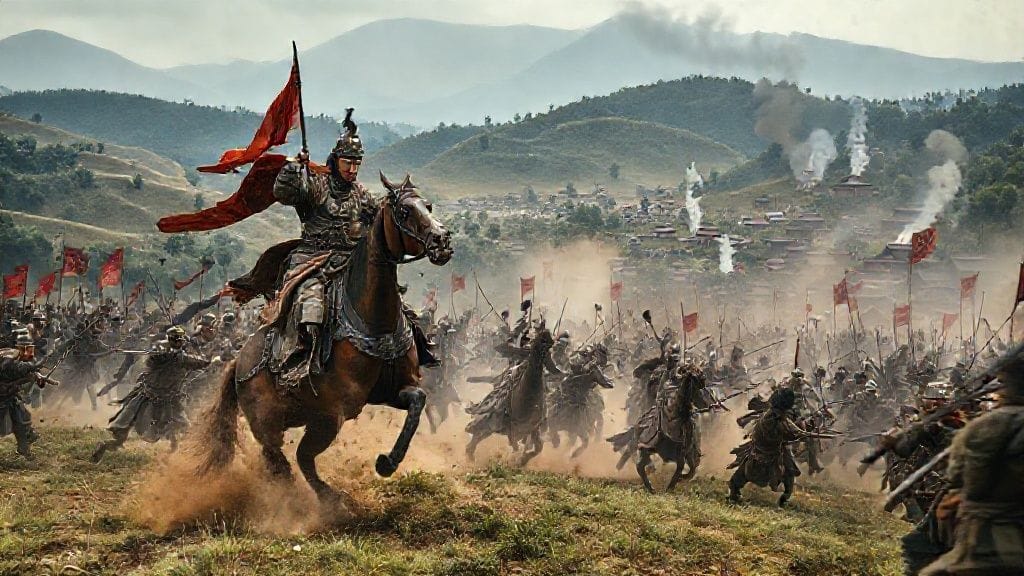
The late 520s were hard years to govern in Iran. Decades of tension with Byzantium had flared into the Iberian War, while aristocratic families and magi guarded their privileges at home. Reformist impulses, briefly encouraged under Kavadh I, left social wounds not yet healed when talk of succession grew urgent.
Administratively, the empire stretched from the frontiers of Mesopotamia to the Caucasus and the eastern marches beyond Merv. Fortresses and passes were expensive to hold, and garrisons needed coin. It is within this setting that the accession of Khosrow I came to embody both danger and possibility.
Across the Tigris at Ctesiphon’s palace complex, officials managed logistics, tribute, and embassies under anxious eyes. The court knew that one misstep—one disputed title, one snub to a great house—could mean revolt on the very day a new crown was raised. Ceremony mattered, but consent mattered more.
02 – Princes and Powerbrokers: The Road to Designation
Kavadh I had ruled since the 480s, surviving deposition and return, and he understood how succession could break an empire. Among his sons, Khosrow emerged as favorite, yet he was not the eldest. Court factions formed around princes and around the powerful clans whose favor crowned or crushed kings.
One unusual diplomatic gambit marked the late 520s. Kavadh reportedly proposed that the Byzantine emperor adopt Khosrow, creating a symbolic tie to strengthen his claim. Procopius recounts the episode with dry skepticism, noting the delicate protocol and mutual suspicion. The initiative faltered, and the palace turned inward to secure legitimacy.
Designation alone could not quiet the great houses of Suren, Mihran, Karen, and others. They measured a candidate by what he promised to preserve or change. Khosrow’s supporters cultivated an image of legal-minded order, signaling that the next reign would tame uncertainties without humiliating entrenched elites.
03 – Kavadh’s Last Decisions and the Succession Question
By 531, the aging Kavadh faced mortality and the unresolved question of who could both command the army and restrain the nobles. Contemporary observers suggest he moved decisively, pressing court opinion toward Khosrow while curbing potential rivals. Death could make such efforts moot, but hesitation could be fatal earlier.
Later narratives describe purges and calculated marriages designed to corral dissent, though details are murky. What seems clear is that Kavadh’s late decisions pushed the balance in Khosrow’s favor. Yet power once announced is still not power held, and palace plots do not pause for mourning rituals.
As word of Kavadh’s death spread through the capital in September 531, factions accelerated their plans. Some nobles looked beyond the named heir, imagining a pliable claimant. Others wagered that swift ceremony, with the army’s assent, could cement the transition before alternatives hardened into rebellion or civil war.
04 – Ctesiphon in September: The Accession as Spectacle
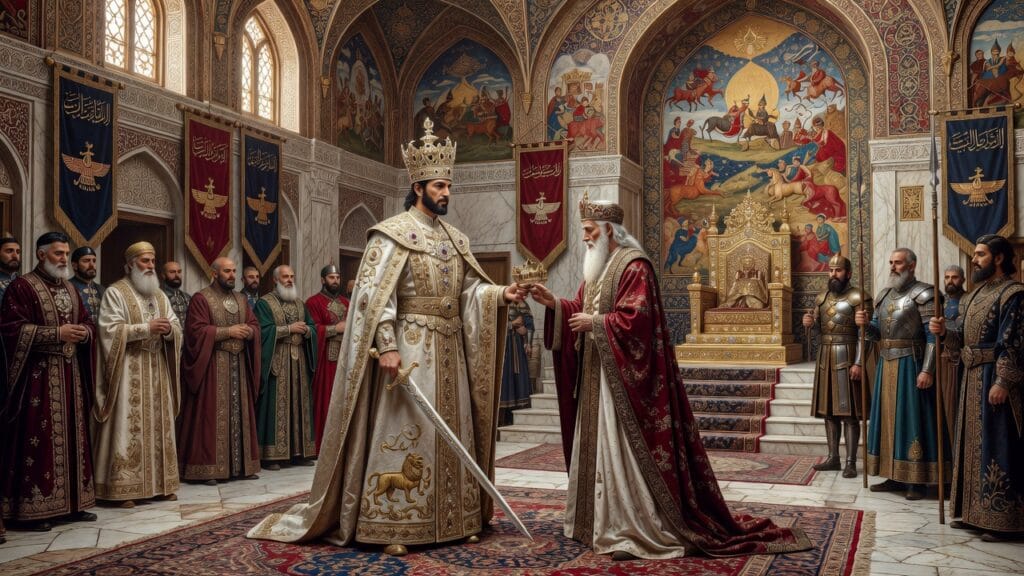
The enthronement unfolded within the sprawling palace complex on the Tigris, where banners, gifts, and oaths turned a legal claim into lived authority. Courtiers staged continuity as much as celebration. A diadem placed in public, a formula pronounced by clergy and nobles, and the army’s acclamation were the tools of survival.
Those ceremonies were never mere theater. In a world where letters and seals traveled slowly, the event itself served as broadcast. The empire’s provincial elites would hear of the rites and calibrate their loyalties. Every gesture signaled policy: leniency or resolve, tradition or correction, largesse or restraint.
Mini timeline:
- c. 528–529: Suppression of Mazdakite movement consolidates court authority.
- September 531: Kavadh I dies; Khosrow is acclaimed at Ctesiphon.
- 532: “Eternal Peace” concluded with Byzantium, stabilizing the western front.
- Mid-530s: Administrative and military reforms deepen, reshaping command and taxation.
Reports vary on exact formulas and participants, but the symbolism is consistent. The new king embodied continuity with the House of Sasan and the promise of restored balance. For audiences at court and along the frontier, the scene announced a ruler intent on order after years of uncertainty.
05 – Inside the Palace: Conspiracy and Countermove
Coronation did not silence opposition. Within months, a coalition led by senior nobles—later chroniclers name Bawi among them—backed a rival royal child as a more controllable sovereign. Conspiracy in Sasanian politics often centered on access to the diadem, but it also sought control of offices and revenues.
Khosrow’s response was swift and exacting. He arrested conspirators, purged suspect branches of the royal family, and reassigned or eliminated officers whose loyalty was uncertain. The violence was targeted, yet its message was broad: the court would not be a place to test the new monarch’s resolve.
The episode set a tone for the reign. Mercy would be offered in laws and taxes, not to plotters who mistook transition for weakness. This combination of severity and administrative patience helped turn the accession from precarious beginning to durable fact, knitting the army and bureaucracy to the throne.
06 – The Quiet Revolution: Centralization after the Crisis
With the palace secured, Khosrow moved to reduce the risks that made conspiracies tempting. Later Persian and Arabic traditions credit him with dividing military command among regional spahbeds, replacing the peril of a single overmighty general with a more balanced frontier system. Even if gradual, the reform’s logic addressed a structural flaw.
Fiscal practices also shifted. Assessments aimed to regularize what had been unpredictable exactions, tethering taxation to land and productivity rather than arbitrary summons. A more reliable stream of revenue could pay troops on time, limit abuses, and dampen the noble temptation to fill gaps with private militias or local extortion.
These measures did not erase the autonomy of great houses or clergy, nor did they instantly solve provincial grievances. But they moved authority closer to the throne without provoking universal backlash. The accession’s political lesson—resolve paired with predictable rules—was being translated into the empire’s daily administration.
07 – Peace with Justinian: Diplomacy as Strategy
While power consolidated at home, the western frontier demanded attention. Justinian I was new to his own imperial project, ambitious in law and war. Both courts could ill afford constant campaigning. In 532, envoys crafted the “Eternal Peace,” a grand name for a truce that bought time and reshaped expenses.
Procopius describes exchanges of prisoners, the return of some fortifications, and payments from Constantinople framed as contributions to guarding Caucasian passes. The terms soothed the Iberian question without resolving its underlying loyalties. More important for Khosrow, peace muted a costly theater and freed resources for domestic priorities.
To contemporaries, this was pragmatic statecraft rather than capitulation or triumph. The accession of Khosrow I had not ushered in a warlord; it elevated a calculator of risks. The quiet that followed did not last forever, but it allowed reforms to grow deep roots before the next storm.
08 – Frontiers in Flux: Armenia, Iberia, and the Steppe
The Caucasus was a mosaic of kingdoms and passes, where loyalties were shaped by trade, kinship, and fear. Iberia and Armenia balanced between the two empires, while highland nobles weighed short-term advantages against long-term survival. Peace reduced raids, but it did not erase the geography that made peripheries restless.
Eastward, the Hephthalites still loomed, and the steppe pathways transmitted both danger and opportunity. Tribute, treaties, and intermarriage all served as instruments of policy. Yet behind every arrangement lay the fundamental question of stamina: could the treasury support garrisons, bribes, and repairs before winter or a new claimant upset the balance?
Here the broader meaning of accession becomes clear. A stable center did not end frontier suffering, but it changed its rhythms. Predictable payments and fewer forced levies could mean safer harvests and trade. The difference between panic and planning, for ordinary people, was the measure of a reign’s success.
09 – Law, Faith, and Order: After Mazdak
In the final years of Kavadh, the radical preacher Mazdak had won influence, urging communal ethics and curbs on elite accumulation. The pendulum had already swung back by 528–529 with brutal suppression. Khosrow’s accession affirmed this reversal, aligning throne and clergy to reassert legal hierarchy and property protections.
Religious policy emphasized Zoroastrian orthodoxy while managing Christian, Jewish, and other communities pragmatically. A regime that punished subversion still needed tax revenue and local expertise. Khosrow’s early rule guarded magian authority yet signaled that imperial law, not only clerical edict, would stabilize society after ideological extremity and reprisal.
Legal rhetoric met practical necessity. Codifying taxes and regularizing justice created fewer incentives for local lords to improvise authority. The accession of Khosrow I thus helped bury the memory of Mazdak’s turbulence, not by forgetting it, but by proposing a different path to fairness: rules before dreams.
10 – Money, Land, and the Army: Reforms in Practice
Reform gathered force in counts and ledgers. Land surveys and cadastres, credited by later administrative texts to Khosrow, established clearer obligations. When soldiers knew pay would arrive and farmers knew what to expect, revolt lost some of its appeal. Predictability acted as a social technology, reducing the need for spectacular coercion.
The army benefited first. Sasanian heavy cavalry, the aswaran, required training, mounts, and equipment too costly for sporadic funding. A steadier fiscal base created confidence that service would be rewarded. Command was reshaped to check concentrations of power, while provincial notables—the dehqans—were tied more tightly to royal interests.
Economic life responded. Merchants along the Tigris and in Gurgan or Ray tracked customs and safe-conduct with a surer hand. A less chaotic tax regime encouraged investment in irrigation and estates. The accession’s meaning, for these men and women, was not ceremony but the daily visibility of rule through roads, posts, and pay.
11 – A World of Learning: Court Culture and Exchange
Stability also fed culture. The court became a conduit for knowledge moving between India, Iran, and Byzantium. Medical scholarship at Gundishapur later flourished under Sasanian patronage, and embassies carried texts and techniques alongside gifts. Translation was politics by other means, anchoring prestige in learning as well as victory.
Traditions remember Khosrow receiving chess from India, a tale of riddling intellect and calculation. Historians treat the story cautiously, yet it captures a truth about the reign’s image: problems were puzzles to be solved with rule-bound moves. Prestige accrued to a monarch comfortable in both camp and library.
Patronage also protected jurists, astronomers, and poets. When the imperial center commanded respect, scholars felt safer to write and debate. The accession of Khosrow I did not invent this world, yet it sharpened its contours, showing how order at the top could foster curiosity and craft below.
12 – From Event to Legacy: Remembering Khosrow’s Beginning
Memory does not remember equally. Khosrow’s later campaigns, including spectacular operations against Byzantine Syria, often overshadow the quieter work of 531–532. But without the stable launch—discipline at court, negotiated peace, fiscal repair—those later exploits would ring hollow, or not occur at all.
The epithet “Anushirvan the Just” attached to Khosrow in later tradition, reflecting aspirations as much as realities. Justice in this sense meant predictability and protection from arbitrary power. Compared to the turbulence of the late fifth century, the early 530s offered a more navigable landscape for subjects and servants of the crown.
It is easy to forget how fragile this world still was. One bad harvest or one misjudged purge could have undone the balance. The fact that it held, through the accession and into reform, is a measure of the political intelligence that set the tone before triumph chased memory’s spotlight.
13 – Reading the Sources with Care
The documentary record for 531 is uneven. Byzantine writers, especially Procopius, emphasize diplomacy and war, filtered through Constantinople’s priorities. Persian and Arabic historians like al-Tabari transmit court stories crafted under later monarchs. Armenian and Syriac chronicles add their own vantage, often highlighting the experience of border societies.
Numbers—sums of gold, lists of fortresses—should be read with caution. Chroniclers sometimes amplified totals to magnify a patron’s triumph or a rival’s humiliation. The same applies to motives: adoption proposals, plots, and edicts survive as narratives that serve memory as much as they report fact.
Still, threads align. A favored heir ascended in September 531; a conspiracy followed and failed; an agreement with Byzantium stabilized the west in 532; and administrative reforms deepened thereafter. Within these contours, historians debate pace and intention, reconstructing a reign that began in anxiety and learned to govern by design.
14 – The Empire Repositioned: Consequences of the Accession
The political consequences of 531 were immediate and cascading. By surviving the first conspiracy and neutralizing rival claimants, Khosrow dissuaded future insurrections at critical junctures. By taking peace rather than plunder, he reorganized state capacities, laying a platform for later projection of force from Lazica to the Levant.
Socially, reforms blunted the extremes of both elite predation and radical leveling. Predictable taxes favored middling landholders and anchored military service. Clerical authority found firmer footing after the turmoil of Mazdak, while plural communities navigated imperial law with greater clarity. Stability did not end hardship, but it changed its logic.
Economically, steadier revenues and protected trade corridors fueled a virtuous circle. Payment to frontier forces reduced the appeal of freelance raiding. Merchants moved with more confidence, and workshops answered to steadier demand. Sovereignty became tangible in coin, contracts, and garrison schedules rather than only in coronation liturgy.
Immediate consequence:
The throne was secured through targeted purges and swift ceremony, while a negotiated peace in 532 bought time to repair finances and command structures after years of attrition.
Long-term consequence:
Reforms in taxation and military organization underpinned a generation of power, enabling later campaigns and shaping the image of Khosrow as a just ruler in both law and memory.
In this sense, the accession of Khosrow I was both an end and a beginning. It closed the book on one kind of instability and opened another chapter in which calculated governance, not improvisation, carried the empire forward.
15 – Conclusion
The Sasanian Empire in 531 stood at a dangerous threshold. Through ceremony, counterplot, and policy, the accession of Khosrow I turned fragility into a program of rule. A peace crafted with Byzantium and reforms in command and taxation offered something precious in Late Antiquity: time to think, and resources to act.
From this foundation emerged the reign remembered as Anushirvan’s. Its later victories and cultural achievements depend on the quiet calculations of the first months. That is the deeper meaning of 531—an accession that redefined what kingship could do, marrying resolve to rules and setting a legacy that outlived the man.
16 – FAQs
- When did the accession take place?
The accession occurred in September 531, shortly after the death of Kavadh I. While some chronicles hint at specific days, the exact date remains uncertain in the surviving record. - Where was Khosrow I acclaimed?
He was acclaimed at Ctesiphon, the Sasanian capital on the Tigris. The palace complex provided the stage for oaths, diadem, and the army’s endorsement, converting a legal claim into effective rule. - Who were the main figures involved?
Khosrow I stood at the center, following the long reign of his father, Kavadh I. Key actors included great noble houses, magian clergy, and, on the diplomatic front, the Byzantine emperor Justinian I and his envoys. - What caused Khosrow’s rise over other princes?
Kavadh favored Khosrow and worked to secure his succession, perceiving him as disciplined and administratively minded. The failure of a proposed Byzantine adoption left the process internal, resolved by palace management, ritual acclamation, and rapid suppression of rivals. - What were the immediate consequences?
Conspiracy followed swiftly but failed. In 532, the “Eternal Peace” with Byzantium calmed the western theater, freeing resources for reforms in taxation and command. The accession of Khosrow I thus shifted the empire from crisis-response to planned governance. - What is the legacy of this accession?
It enabled a generation of Sasanian strength and the image of Khosrow as “the Just.” Administrative regularity, cautious diplomacy, and cultural patronage all trace back to the stable launch achieved in 531. Many historians view the accession of Khosrow I as a pivot for the late antique Near East.
17 – External Resource
18 – Internal Link
Other Resources
- Encyclopaedia Britannica – general search for the exact subject
- Google Scholar – academic search for the exact subject
- Internet Archive – digital library search for the exact subject
Sources and References
-
Procopius of Caesarea, History of the Wars, Books I–II.
Translation in: Procopius, History of the Wars, Books I–II, trans. H. B. Dewing, Loeb Classical Library, Harvard University Press, 1914–1940.
Note: Greek contemporary narrative that describes the political situation in the Near East around 531, including the death of Kavadh I, the accession of Khosrow I, and the early stages of Khosrow’s relations and warfare with Justinian I of Byzantium, giving context for the circumstances of his rise to power. -
al-Ṭabarī, The History of al-Ṭabarī, Volume V: The Sāsānids, the Byzantines, the Lakhmids, and Yemen.
Translated and annotated by C. E. Bosworth. Albany: State University of New York Press, 1999.
Note: Major early Islamic chronicle preserving Sasanian traditions on the succession of Khosrow I, court politics under Kavadh I, and the internal struggles among Kavadh’s sons, including accounts of how Khosrow secured the throne and eliminated rivals. -
Brock, Sebastian. “Khusro I Anōshirvān.” In: Encyclopaedia Iranica, online edition, Center for Iranian Studies, Columbia University, updated 2016. Available at: https://iranicaonline.org (search “Khusro I Anoshirvan”).
Note: Scholarly overview of Khosrow I’s reign and reforms, used for details on his accession date (531), dynastic background, and the broader political and administrative changes that followed his coming to power in the Sasanian Empire. -
Dignas, Beate and Winter, Engelbert. Rome and Persia in Late Antiquity: Neighbours and Rivals. Cambridge: Cambridge University Press, 2007.
Note: Academic monograph providing a detailed analysis of Roman–Sasanian relations in the sixth century; supports information on the geopolitical context of Khosrow I’s accession, the frontier conflicts around 531, and the diplomatic dimension of his early reign. -
Frye, Richard N. The Heritage of Persia. London: Weidenfeld & Nicolson, 1962.
Note: Classic survey of Iranian history by a leading Iranologist; used for the narrative outline of Kavadh I’s reign, the succession issues leading up to 531, and the characterization of Khosrow I as a pivotal reforming monarch in Sasanian history. -
Gyselen, Rika. “Sasanian Empire.” In: Encyclopaedia of Ancient History, Wiley-Blackwell, 2013; and related numismatic studies by the same author.
Note: Provides evidence from seals and coinage for the titulature and representation of Khosrow I as king, including the use of regnal imagery shortly after his accession, supporting statements about royal ideology at the time he took the throne. -
Howard-Johnston, James. “The Sasanian Empire.” In: The Cambridge History of Iran, Volume 3(1): The Seleucid, Parthian and Sasanian Periods, edited by E. Yarshater. Cambridge: Cambridge University Press, 1983, pp. 116–180.
Note: Authoritative chapter used for the broader institutional and military context of the Sasanian state in the early sixth century, including the structures of power and elite competition that framed Khosrow I’s accession in 531. -
British Museum. “Khosrau I (Anōshirvān).” Collection database and object descriptions, Department of the Middle East, British Museum, London. Accessible via: https://www.britishmuseum.org/collection (search “Khosrau I”).
Note: Museum records and curatorial notes on sixth‑century Sasanian coins and metalwork linked to Khosrow I, used to corroborate his titles, iconography, and the chronological framework of his reign beginning in 531.