Table of Contents
- The City and the Northern Horizon: Constantinople in 860
- The Rus’ on the Move: Traders, Raiders, and River Highways
- Early Warning Signs: Intelligence, Rumor, and the Steppe
- June 860: A Fleet Appears on the Bosporus
- Panic and Defense: Walls, Prayers, and Improvised Strategy
- The Emperors Absent: Michael III and the Arab Front
- The Patriarch’s Role: Photius and the Veil of the Theotokos
- Fire and Plunder: What the Rus’ Actually Did
- Negotiation or Miracle? How the Siege Ended
- Memory and Propaganda: Turning Crisis into Narrative
- Rus’–Byzantine Relations After 860: Trade, Tribute, Baptism
- The Question of Identity: Who Were the Attackers?
- Economics of a Raid: Silver, Slaves, and Timber
- Long Shadows: The Road to the 907 and 941 Campaigns
- Conclusion
- FAQs
- External Resource
- Internal Link
Article Summary: On a June day in 860, sails darkened the Bosporus, and a sudden raid by a Rus’ fleet caught Constantinople exposed. This article reconstructs the attack, contrasts sources, and follows its consequences into politics, religion, and trade. It weighs Photius’s sermons against later chronicles and Western notices. It argues that the event fused miracle, memory, and diplomacy. It shows how a peripheral enemy forced the empire to recalibrate. The term rus attack on constantinople appears in debates, but the history is larger than a keyword.
Why keep reading: Because an empire famed for invincible walls was nearly surprised into catastrophe. At stake is how sudden violence, sacred ceremony, and hard negotiation reshaped Byzantium’s northern frontier—and how a raid turned into a century-long relationship of rivalry and exchange.
At a glance:
- Event: Rus’ maritime raid on Constantinople and its environs
- Date: 18 June 860 (traditional), with some sources shifting parts of the episode into 861–866
- Place: Constantinople, the Bosporus, and suburban settlements along the Propontis
- Main figures: Emperor Michael III; Patriarch Photius; court minister Bardas; unnamed Rus’ leaders, possibly identified later as Askold and Dir
- Why it mattered: Forced Byzantine strategic adaptation, shaped religious memory, and opened channels that later produced treaties, missions, and conversion.
01 – The City and the Northern Horizon: Constantinople in 860
In 860 Constantinople was the jewel of the eastern Mediterranean, bristling with sea walls and crowned by dome and palace. Its defenses were famous, but military attention leaned south and east where Arab campaigns pressed the frontiers. The northern horizons, defined by river routes and distant forests, seemed less urgent and more mysterious.
Every Byzantine strategy assumed the walls were the ultimate answer if danger reached the capital. Ships, too, were a comfort, for the imperial navy guarded the inner seas. Yet no fortification works if a fleet appears without warning, when the emperor is away and the bureaucracy is stretched.
At the city’s heart, religious life pulsed through the Great Church and the Blachernae shrine, shaping political legitimacy. Processions, relics, and sermons spoke to a people who expected sacred protection. It is easy to forget how fragile this world still was, balanced on networks of supply, rumor, and rushed decisions.
02 – The Rus’ on the Move: Traders, Raiders, and River Highways
To the north, the Rus’ were consolidating trading nodes along the Dnieper and Volga. They navigated river portages and bottlenecks with practiced efficiency, stitching together the Baltic and Black Sea worlds. Their longships could drift down quiet backwaters or lash through open stretches, threatening settlements that assumed distance equaled safety.
These groups were not a single monolith but fluid coalitions of Scandinavians, Finnic peoples, and Slavic communities, organized around leaders who mixed commerce and predation. Tribute caravans and raiding parties overlapped. The same men who bartered furs and slaves might raid a poorly defended monastery or riverside village the next season.
Byzantium knew them through trade at Cherson and through embassies that hinted at profit and peril. Contemporary sources suggest previous contacts, but not this scale of audacity. The surprise in 860 revealed how little the empire understood of politics upriver, where a few decisions could send a fleet toward imperial suburbs.
03 – Early Warning Signs: Intelligence, Rumor, and the Steppe
Frontier intelligence was a patchwork of merchants’ tales, monastic letters, and reports from governors on the Black Sea coast. Warnings could be abundant yet imprecise, clouded by fears of steppe movements or pirate bands. By the time a message reached the capital, events might have already shifted downstream.
Modern historians debate whether Byzantine leaders received specific alerts about a Rus’ fleet forming in 860. The documentary record is fragmentary, and the empire’s attention focused on the Arab frontier. Even so, a raid of this magnitude needed only days of carelessness and favorable winds to become a metropolitan crisis.
Western notices, like the Annals of St. Bertin, mention embassies that alluded to northern threats and Byzantine entanglements. But these references are slight, filtered through Carolingian priorities. The surviving evidence points toward a capital that recognized northern dangers in the abstract, but not in the form that arrived in June.
04 – June 860: A Fleet Appears on the Bosporus
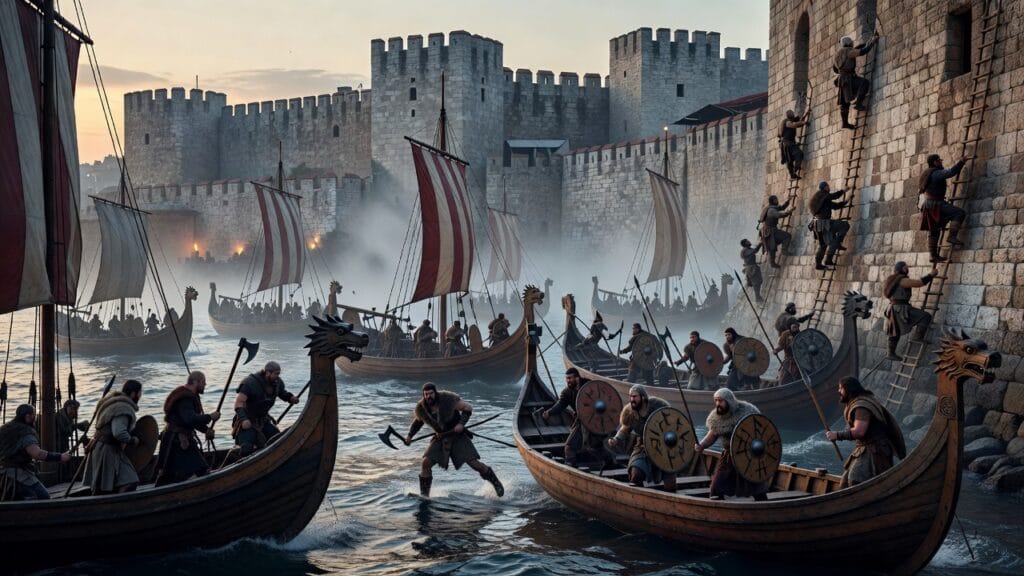
One account places the arrival on 18 June 860, when Constantinople’s waters filled with unfamiliar prows. The city’s suburbs, less protected than the sea walls, were first to feel the blow. Fires rose along the shoreline, and people ran toward the fortifications, clutching icons, tools, or children in a confusion that felt unprecedented.
The attackers struck at villas, monasteries, and markets dotted along the Propontis. Their speed mattered as much as their ferocity. The imperial fleet was away, the emperor on campaign, and coordination lagged behind the pace of destruction. The city itself stood, but its skin—harbors, storehouses, and chapels—tore under a sudden, practiced hand.
05 – Panic and Defense: Walls, Prayers, and Improvised Strategy
Inside the land walls, order had to be remade quickly. Militia units assembled on short notice, and port officials secured chains across key harbors. The logic was containment: keep the raiders from finding a weak gate, buy time until imperial forces returned, and project enough resolve to limit more daring assaults.
Civic and religious rituals intensified. People gathered at churches, asking for intercession, while messengers sped toward commanders on the Asian side. Improvised patrols watched the shoreline at night. For ordinary residents, survival meant exhausting measures—moving relatives into crowded quarters, rationing bread, and listening for news that might or might not be true.
Byzantine society was practiced in ceremony for crisis, but ceremony did not put ships in the water. The gap between symbol and steel, between sermon and sortie, defined the first days. Still, ritual had a function: it held the city together while plans coalesced and the empire looked for a lever to pull.
06 – The Emperors Absent: Michael III and the Arab Front
Emperor Michael III and his uncle Bardas were campaigning against Arab forces when the raid broke. Strategically, this made sense; the danger to Anatolia and the eastern frontier was chronic and deadly. But it meant the core of the army and the best admirals were away when the Bosporus flashed with unfamiliar sails.
Messages reached the imperial camp, forcing decisions at distance. Should the emperor abandon a major campaign and race home, or trust the capital to hold? Modern historians remain cautious because the surviving record is fragmentary, yet several narratives suggest that returning forces were slow to assemble, leaving the city exposed for weeks.
Mini timeline:
- Early June 860: Rus’ fleet departs the Black Sea coast, timing its run with favorable winds.
- 18 June 860: First appearance at Constantinople; suburban raids begin along the Propontis.
- Late June–July 860: Continued plunder and shoreline attacks; imperial forces recalled in haste.
- August 860 (approx.): Rus’ withdrawal amid changing conditions, negotiations, or both.
07 – The Patriarch’s Role: Photius and the Veil of the Theotokos
In the absence of the emperor, Patriarch Photius emerged as the city’s most visible authority. His sermons, delivered during the crisis and shortly after, stressed repentance, unity, and divine protection. He organized processions with holy relics, including the famed veil of the Theotokos at the Blachernae shrine, to ask for deliverance.
Later chroniclers claimed that the relic was dipped in the sea, stilling the waters and scattering the attackers. Photius himself emphasizes prayer and unity more than spectacle, yet the tradition remembers a moment when sacred power shielded the capital. This memory, polished by repetition, would frame the narrative for generations.
08 – Fire and Plunder: What the Rus’ Actually Did
What the Rus’ accomplished was not a formal siege but an aggressive coastal raid. They burned churches and villas, seized captives for ransom or sale, and struck at warehouses that fed the capital. They tested the empire’s outer layers, not the inner citadel. The walls held; the suburbs and sea lanes buckled.
Descriptions of slaughter in later texts can read like moral lessons as much as reports, but the violence was real. Maritime raiders profited by speed and terror, not attrition. Each torch and scream bought time for their leaders to decide the next blow or slip away before organized relief could arrive from the imperial field armies.
09 – Negotiation or Miracle? How the Siege Ended
How the crisis ended is debated. One strand of memory insists on a miracle tied to the Theotokos, pointing to sudden storms that scattered ships. Another suggests that the Rus’ achieved their aims—loot and leverage—and withdrew before imperial forces boxed them in. Neither excludes the other; weather and calculation often conspire in coastal war.
Contemporary sources suggest a withdrawal after weeks of pressure, followed by efforts to define what had happened. Ceremonies thanked God for deliverance, while envoys and informants traced the raiders’ path back up the Black Sea. The empire needed a framing story, not only to soothe the city, but to signal control to friends and enemies.
It is astonishing how much political weight could rest on a sermon, a storm, or a rumor of negotiations. The victory solved one problem and created another: how to deter a repeat without abandoning priorities elsewhere. Byzantium began looking north not simply with anger, but with questions that would shape policy for decades.
10 – Memory and Propaganda: Turning Crisis into Narrative
In the months after the raid, imperial and ecclesiastical rhetoric did double duty. It soothed a population traumatised by sudden violence and reasserted the empire’s aura of security. Photius’s sermons provided a template: sin had invited punishment; repentance and divine favor restored order. The narrative made the inexplicable legible.
But this was only the beginning of the story-making. Court chroniclers elaborated episodes into coherent drama. Later writers emphasized the veil of the Theotokos and miraculous intervention, tying the event to Constantinople’s sacred geography. The empire’s prestige drew strength from being seen as chosen, even—or especially—when tested by unlikely foes.
This turn to memory mattered diplomatically. It justified resilience to foreign courts and calmed internal critics of military leadership. Simultaneously, practical steps followed behind the music of words: inquiries into naval readiness, adjustments to harbor defenses, and more structured contact with the northern polities now impossible to ignore.
11 – Rus’–Byzantine Relations After 860: Trade, Tribute, Baptism
After 860, contacts multiplied. The Rus’ learned that a raid could sting but not topple the capital, and that Byzantine wealth was best approached through bargaining as often as through blades. Embassies came with demands and offers, and the court weighed tribute against costs. Treaties in 907 and 911 eventually codified practices of trade and justice.
Religion entered the equation, carefully. Missionary efforts took shape, and later tradition places the baptism of Rus’ envoys or rulers in a chain of contacts that echoed the shock of 860. Constantine Porphyrogenitus, writing in the tenth century, would describe river routes and diplomatic choreography that matured after early collisions.
Commerce grew bolder. Rus’ merchants arrived with furs, beeswax, and slaves, and left with silk, wine, and coin. Byzantine officials practiced containment by regulation, funneling northern traders into designated harbors and supervising markets. The memory of 860 hovered as a cautionary tale, ensuring that hospitality always came with rules.
12 – The Question of Identity: Who Were the Attackers?
Were the raiders led by figures remembered later as Askold and Dir? The Primary Chronicle, compiled centuries later, associates leaders with an attack dated to 866 and a miracle at the Blachernae. Modern historians debate whether this reflects an earlier memory reframed by later politics, or a distinct episode conflated with 860.
Archaeology offers broad strokes rather than names: Scandinavian-style weaponry in riverine contexts, mixed with Slavic material culture, supports the fusion character of Rus’ coalitions. The empire’s own records, sparse for names, describe the enemy by maritime capability and audacity. If a single chieftain sought fame, the Byzantine archive kept it secondary.
Identity in the ninth century north was a moving target. Coalitions rose and fell around boats and plunder rights more than fixed thrones. The attack’s anonymity is instructive: to Constantinople, what mattered was not who asked for the oars to bite, but that new worlds upriver could reach imperial waters in force.
13 – Economics of a Raid: Silver, Slaves, and Timber
Raiding had its own arithmetic. The Rus’ sought portable wealth—silver coin, jewelry, fine cloth—and human beings. Slaves could be marched or shipped northward and sold along the Dnieper or across the Volga to markets that connected to the Islamic world’s appetite for labor. Each captive represented a ledger entry in a grim economy.
For Byzantium, the damage struck supply lines and confidence. Even if grain stores were safe within the city, the loss of shoreline warehouses and fishing capacity tightened prices. Merchants demanded assurances before landing goods, and insurers—formal or informal—raised expectations of imperial protection. Security measures, from extra patrols to harbor chains, were expensive.
The economic cost also shaped policy. Tribute, when paid, could be cheaper than rebuilding fleets from scratch or garrisoning every inlet. Regulated trade provided channels to profit and intelligence. The raid thus did not merely take; it taught accounting lessons that both sides would remember as they drifted from battle to bargaining.
14 – Long Shadows: The Road to the 907 and 941 Campaigns
The 860 raid did not end northern pressure. It seeded a longer arc of testing, culminating in the dramatic 907 expedition recorded in the Primary Chronicle and the disastrous 941 campaign repelled with Greek fire. Each return linked back to 860, when raiders first tasted the edges of imperial wealth and resolve.
By 907, the Rus’ and Byzantines were drafting treaties that named trading days, judicial procedures, and harbor rules. By 941, the empire had refined naval countermeasures and intelligence networks. These developments read like answers to questions posed in 860: How fast can relief arrive? Where do river fleets hurt most? What promises buy peace?
Memory shaped policy just as much as policy shaped memory. Stories of miracles at the Blachernae stood beside lists of treaty clauses. The Byzantines learned not to mistake sacred confidence for strategic complacency. The Rus’ learned that terror opened doors, but law kept them ajar. The balance defined a century of contact.
Immediate consequence:
Constantinople’s suburbs burned, coastal defenses tightened, and the empire rushed to reposition fleets and recall forces. Ceremonies of thanksgiving reframed trauma as deliverance while the court recalibrated its northern risk assessments.
Long-term consequence:
Structured treaties, regulated trade, missionary efforts, and periodic wars followed. The raid anchored a durable mental map in Constantinople: northern river powers could threaten quickly, so deterrence and diplomacy must be continuous rather than episodic.
15 – Conclusion
The episode remembered as the 860 raid, often summarized in the phrase rus attack on constantinople, was less a single plot than a collision of rhythms: a mobile river power met a ceremonial metropolis. The city did not fall. Instead, Europe’s hinge pivoted a notch, aligning trade, law, and missionary politics with new northern realities.
Its legacy unfolded in treaties, conversions, and later campaigns, but also in the architecture of memory—sermons, processions, and the enduring prestige of relics at the Blachernae. The capital learned that invincibility required vigilance and flexibility. The Rus’ learned that terror opened markets and doors to negotiation, creating a century-long conversation across the Black Sea.
16 – FAQs
- When did the attack occur?
The traditional date is 18 June 860, though some later sources shift elements of the story into the mid-860s. Modern scholars treat 860 as the core event while acknowledging chronological confusion in later chronicles. - Where did the fighting take place?
Along the Bosporus and the Propontis around Constantinople. The city walls held, but coastal suburbs, churches, warehouses, and smaller harbors suffered raids, fires, and plunder. - Who led the attackers and defenders?
On the Byzantine side, Emperor Michael III and the minister Bardas were away campaigning; Patriarch Photius coordinated the city’s spiritual response. The Rus’ leaders remain unnamed in contemporary Byzantine sources, with later tradition proposing figures like Askold and Dir. - Why did it happen?
Profit, leverage, and opportunity. The Rus’ exploited river and sea routes to strike when the imperial fleet was dispersed. The raid aimed at loot, captives, and political advantage rather than a formal siege of the city itself. - What were the consequences?
Immediate tightening of coastal defenses, ritualized thanksgiving, and renewed naval readiness. Long term, the raid helped catalyze treaties, regulated trade, missionary contact, and a pattern of periodic warfare and negotiation into the tenth century. - What is the lasting legacy?
The raid reoriented Byzantine attention northward and embedded a religious memory of deliverance. It also inaugurated a structured, sometimes hostile, sometimes cooperative relationship with the Rus’—the backdrop to later embassies and to narratives summarized today as the rus attack on constantinople.
17 – External Resource
18 – Internal Link
Other Resources
- Encyclopaedia Britannica – general search for the exact subject
- Google Scholar – academic search for the exact subject
- Internet Archive – digital library search for the exact subject
Sources and References
-
Photios I of Constantinople. Homilies on the Occasion of the Siege of Constantinople by the Rus’ (860), in Cyril Mango (ed. & trans.), The Homilies of Photius Patriarch of Constantinople. Cambridge, MA: Harvard University Press, 1958.
Primary source. Provides an eyewitness, contemporary description of the Rus’ naval assault on Constantinople in 860, the element of surprise, the city’s unpreparedness, and the religious framing of the event by the patriarch. -
Theophanes Continuatus. Theophanes Continuatus: Chronographia, in R. C. McCail (trans.), selections in Byzantine Chronicles. Various manuscript traditions, 10th century.
Primary source. Offers a later Byzantine narrative of the 860 Rus’ raid, including chronology, basic outline of the attack, and the broader context of imperial campaigns that left Constantinople vulnerable. -
Shepard, Jonathan. “The Viking Rus and Byzantium.” In The New Cambridge Medieval History, Volume II: c. 700–c. 900, edited by Rosamond McKitterick, 495–521. Cambridge: Cambridge University Press, 1995.
Modern scholarly analysis. Discusses political and diplomatic relations between the Rus’ and Byzantium in the 9th century, including the 860 attack, its possible motives, and its place within broader Rus’–Byzantine interaction. -
Franklin, Simon, and Jonathan Shepard. The Emergence of Rus 750–1200. London and New York: Longman, 1996.
Modern monograph. Provides detailed background on the development of the Rus’ polity, their trading and raiding patterns in the Black Sea, and situates the 860 attack within the early history of Rus’ expansion and contacts with Constantinople. -
Haldon, John. The Byzantine Wars: Battles and Campaigns of the Byzantine Era. Stroud: Tempus, 2001.
Modern secondary source. Summarizes the military aspects of the 860 Rus’ raid, the state of Byzantine defenses, and the strategic situation of the empire during Michael III’s reign. -
“Rus’ Attack on Constantinople (860).” In Encyclopaedia of the Hellenic World, Constantinople. Foundation of the Hellenic World.
Scholarly online encyclopedia entry. Offers a concise overview of the chronology, main actors, and outcomes of the 860 attack, as well as its significance for subsequent Rus’–Byzantine relations. -
Herrin, Judith. Byzantium: The Surprising Life of a Medieval Empire. London: Penguin, 2009.
Modern synthesis. Provides broader context on the Byzantine Empire in the 9th century, including the role of Constantinople as an economic and religious center and the nature of external threats such as the Rus’ raid of 860. -
Mango, Cyril. “Byzantine Contacts with the North.” In Byzantium and Its Image: History and Culture of the Byzantine Empire and Its Heritage, 213–229. London: Variorum Reprints, 1984.
Modern scholarly study. Explores contacts between Byzantium and northern peoples, including the Rus’, and helps contextualize the 860 attack within patterns of trade, diplomacy, and warfare in the Black Sea and Baltic regions.

