Table of Contents
- Rome and Constantinople in 438: An Empire Needing Order
- The Commission of 429: Ambition in the Archives
- From Project to Policy: The 435 Restart
- The Day of Proclamation in Constantinople
- Anatomy of a Code: Sixteen Books
- Faith and Heresy in Imperial Statutes
- Households, Status, and the Everyday
- Money, Offices, and the Late Roman State
- The Western Embrace: Valentinian III and 439
- Making Law Work: Judges, Governors, and Practice
- Sources and Silences: Reading the Theodosian World
- Afterlives: From Breviary to Justinian
- What Changed—and What Didn’t
- Conclusion
- FAQs
- External Resource
- Internal Link
Article Summary: On 15 February 438, in Constantinople, Emperor Theodosius II ordered the formal publication of the Theodosian Code, a monumental collection of imperial laws from Constantine to his own time. The work aimed to clarify and standardize Roman legislation across a complex, divided empire. This article traces the ambitions behind the project, the ceremony of promulgation, and the rollout that followed. It also examines religious, social, and fiscal regulations embedded in the text. We consider uncertainties in the surviving record and the code’s long afterlife, including its influence on Justinian. Throughout, we assess the stakes and legacy of the theodosian code promulgation.
Why keep reading: This was not merely a legal publication—it was a declaration of who held authority over the late Roman world and how daily life would be ordered. Behind the ceremony lay fierce disputes over faith, property, and power that the code sought to settle but could never fully silence.
At a glance:
- Event: Promulgation of the Theodosian Code (Codex Theodosianus)
- Date: 15 February 438 in the East; recognized in the West later that year; generally effective across both halves by 1 January 439
- Place: Constantinople, with empire-wide distribution
- Main figures: Emperor Theodosius II; leading jurists and the imperial chancery, notably the quaestor Antiochus Chuzon
- Why it mattered: It standardized imperial law after a century of piecemeal decrees, shaping administration, religion, and society, and laying groundwork for Justinian’s reforms.
01 – Rome and Constantinople in 438: An Empire Needing Order
In 438, the Eastern Roman Empire was both remarkably stable and deeply anxious. Constantinople’s walls loomed unbroken, tax ships still crossed the seas, and courtiers mastered the art of governing a complex world by paper, seal, and oath. Yet laws multiplied across decades, creating a maze that governors and petitioners struggled to navigate.
By Theodosius II’s long reign, authority traveled through filing rooms as much as through battlefields. The imperial chancery needed certainty to keep judges synchronized, municipalities afloat, and church disputes contained. The code promised clarity. The stakes of the theodosian code promulgation were therefore administrative, political, and profoundly human.
It is easy to forget how fragile this world still was. The memory of civil war and religious strife lingered, and the frontiers could not always hold. A law code would not stop raids, but it could prevent chaos inside the walls—by telling officials exactly what to do, and punishing them if they failed.
02 – The Commission of 429: Ambition in the Archives
In 429, Theodosius II announced a sweeping project: gather imperial constitutions, resolve contradictions, and assemble them into an authoritative, public code. The emperor promised rationality where there had been confusion, and publicity where obscure rescripts had governed. The commission’s brief was audacious—order a century of evolving policy without losing imperial prestige.
The task fell to senior jurists of the court, led by the quaestor Antiochus Chuzon. Their challenge was not mere copying; it was selection and synthesis. Thousands of enactments, sometimes overlapping or obsolete, had to be culled, harmonized, and arranged to guide judges in provinces stretching from Egypt to the Balkans.
Modern historians debate how far this first commission progressed before stalling. The surviving evidence points toward painstaking archival labor, complicated by jurisdictional rivalries and the difficulty of reconciling earlier codes like the Gregorian and Hermogenian collections with current needs. The project needed renewed political will to reach the finish line.
03 – From Project to Policy: The 435 Restart
In 435, Theodosius II restarted the project with sharper instructions: focus on imperial constitutions from Constantine onward, arrange them by subject into sixteen books, and ensure they carried the force of law once published. The emphasis shifted from encyclopedic memory to functional governance, a change with immediate practical implications.
By narrowing the chronological scope and clarifying editorial aims, the court sought to accelerate completion. The chancery aimed to attach headings, cross-references, and precise dating to each constitution. This would turn scattered enactments into a navigable map—a tool meant as much for daily decisions as for imperial display.
Contemporary sources suggest the restart brought renewed energy and a more disciplined methodology. The measure of success would not be elegance but usability: could a governor in Africa, a bishop in Syria, or a municipal official in Thrace find answers quickly, and rely on them under legal scrutiny?
04 – The Day of Proclamation in Constantinople
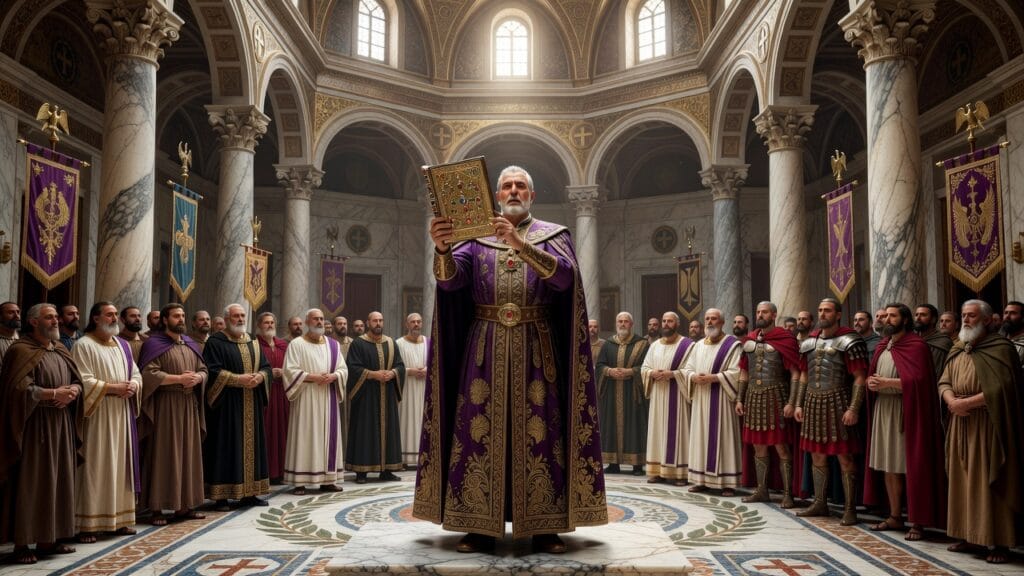
On 15 February 438, the emperor’s ordinance declared the code officially published in Constantinople. Contemporary procedure likely combined a formal reading to the Senate with orders for public posting and copies dispatched to provincial capitals. The moment joined ceremony with logistics, turning vellum and directives into enforceable law.
The promulgation signaled that the text was no longer internal draft work. It mandated compliance by judges and administrators, fixing penalties for those who ignored the new arrangement of rules. Yet behind the ceremony lay a massive courier effort, scribal rooms at full stretch, and governors preparing to reconcile local practice with imperial clarity.
But this was only the beginning. To matter, the code had to be read, taught, cited, and enforced. The chancery’s success would be measured not by the applause in Constantinople, but by the daily decisions of provincial courts from Ravenna to Alexandria a year later.
Mini timeline:
- 429: Theodosius II commissions a comprehensive legal collection.
- 435: Project renewed; scope fixed to Constantine onward; plan for sixteen books.
- 438 (Feb 15): Code promulgated in Constantinople; distribution begins.
- 439 (Jan 1): General effective date across East and West after Western recognition.
05 – Anatomy of a Code: Sixteen Books
The editors arranged the code into sixteen books covering categories from imperial officials and judicial procedures to property, contracts, and family life. The final book gathered church and religious matters, revealing priorities as much as structure. Each title stitched together constitutions across reigns, producing a layered, chronological chorus.
Unlike juristic digests, this collection presented imperial constitutions—binding enactments rather than scholarly opinions. Many entries began with a date and an addressee, signaling the bureaucratic channels that once handled them. By aligning form and function, the editors invited judges to apply rules with confidence rather than rummage through contradictory scraps.
Language mattered, too. Though the empire was bilingual, the codification spoke Latin, the traditional legal idiom of Roman rule. Translators and intermediaries would later convey content in Greek for local use, but legal prestige still traveled with Rome’s ancient tongue, reinforcing a sense of continuity even amid reform.
06 – Faith and Heresy in Imperial Statutes
Book sixteen codified a century of church policy: affirmations of Nicene orthodoxy, restrictions on heretical assemblies, protections and privileges for clergy, and renewed measures against public pagan sacrifice. This was law as theological boundary-setting, framing religious identity through imperial authority and defining who could act publicly without penalty.
Yet behind the confident edicts lurked complex realities. Pagan practices persisted in local rites; Jewish communities navigated new constraints while retaining recognized status; doctrinal disputes among Christians themselves hardly ceased. The code’s neat titles could not resolve fourth- and fifth-century debates, but they did tilt the legal field toward defined orthodoxy.
The Liber Pontificalis preserves a later but influential memory of episcopal authority expanding under imperial favor. Still, modern historians remain cautious: the documentary record is fragmentary, and provincial application likely varied. The code offered a baseline; life on the ground supplied exceptions, evasions, and negotiations that defy simple narratives.
07 – Households, Status, and the Everyday
Beyond doctrine, the code spoke to home and street. It cataloged rules on marriage, dowry, guardianship, and inheritance, while mapping status distinctions between honestiores and humiliores, citizens and slaves, freeborn and freed. Lawmakers aimed to protect family property, define obligations, and curb abuses—especially in guardianship and manumission procedures.
These were not abstract principles. A widow calculating her dotal rights, a guardian accounting for a minor’s estate, a freedman seeking proof of liberty—all needed predictable rules. Clear appeal deadlines and penalties for malfeasance sought to shield the vulnerable, though ideals often collided with economic pressures and neighborhood power.
The code’s household regulations also revealed Roman continuity amid Christianization. While religious provisions shaped public identity, civil statutes preserved long-standing property tools. The result was a legal culture that felt recognizably Roman even as it endorsed new moral priorities from the palace and the pulpit.
08 – Money, Offices, and the Late Roman State
Fiscal rules threaded the code like iron through stone. Laws enumerated taxes, grain levies, and the burdens of municipal councils, the curiales who struggled to keep cities solvent. Other titles combated corruption, punished extortion, and disciplined bureaucrats who turned public office into private profit—a persistent late Roman anxiety.
Here, the code served administration as much as justice. Governors required crisp instructions for tax arrears, exemptions, and audits; they needed procedures that a notary could cite and a treasurer could enforce. The Notitia Dignitatum shows the administrative ladder; the code tried to make that ladder sturdy enough to climb without falling.
Yet the victory solved one problem and created another. Strict fiscal norms sometimes accelerated urban decline by squeezing elites tasked with civic expenses. The code recognized this with occasional relief measures, but the broader trend was unmistakable: the state’s hunger for revenue, formally justified and carefully registered, never abated.
09 – The Western Embrace: Valentinian III and 439
Acceptance in the West turned a court project into an imperial one. Later in 438, Emperor Valentinian III recognized the code, and by 1 January 439 it generally took effect across both halves. The Senate of Rome received copies, and provincial authorities in the Western prefectures were ordered to align rulings accordingly.
This transfer was political theater and practical alignment. It affirmed that despite political differences, Rome’s law remained a shared language. The theodosian code promulgation thus bridged the Adriatic, setting a standard for judges from Carthage to Arles and tightening the cords of imperial cohesion one rubric at a time.
Over the next decades, Western kingdoms would quote or adapt the code, most famously in the Breviary of Alaric (506). That compilation, with its interpretatio clarifying Roman rules for Gothic subjects, shows how the code’s authority outlived imperial borders, traveling where emperors no longer did.
10 – Making Law Work: Judges, Governors, and Practice
Publishing a code is one matter; making it work is another. Provincial judges needed training to search titles, reconcile earlier rulings, and apply penalties precisely. Governors coordinated with city councils and tax officers, while advocates learned to frame arguments with book and title, not rumor or local precedent.
Language mediated reality. Many officials in the East spoke Greek as a first language, though the text was Latin. Translators, glossators, and legal secretaries became crucial, producing summaries and explanatory notes that carried the code into courtrooms and archives from Antioch to Alexandria.
Not every official welcomed the discipline. Some lost room for discretionary favors; others bristled at new oversight mechanisms. But as citations multiplied and appeals referenced standardized titles, the habit of ruling by codified norm rather than ad hoc rescript took firmer root, even where enforcement remained imperfect.
11 – Sources and Silences: Reading the Theodosian World
The code survives imperfectly, mainly through medieval manuscripts and Western adaptations that preserved much of its text. Its official preface, preserved in later copies, explains the editors’ aims and the penalties for ignoring provisions. Yet gaps remain, and some constitutions reach us only through paraphrase or citation in other legal works.
Modern historians remain cautious because the surviving record is fragmentary. The Sirmondian Constitutions, transmitted separately, illuminate areas otherwise dim, while the Breviary of Alaric preserves Western readings of many titles. The result is a mosaic: enough to see the design clearly, though edges and colors sometimes blur.
Scholars often use the standard English translation to follow the arrangement and spirit of the text, but they warn against assuming uniform enforcement. Provincial variation, local disputes, and the realities of travel and copying complicate any simple claim about reception in 438–439.
12 – Afterlives: From Breviary to Justinian
The code’s influence did not end with imperial titles. In the West, the Visigothic Breviary of Alaric (506) incorporated many provisions with explanatory glosses, guiding mixed populations under Gothic kingship. Other post-Roman polities borrowed selectively, treating Roman legal heritage as a toolkit rather than a complete blueprint.
In the East, the text prepared the ground for Justinian’s sixth-century reforms. When Justinian ordered the Codex Iustinianus in 529 and later the Digest, his jurists stood on Theodosian shoulders. They kept the idea of organized imperial law, expanded the corpus, and reasserted that the emperor was the living source of legislation.
Canon law, too, found a partner in the code’s religious titles, shaping ecclesiastical courts for centuries. Even where precise wording faded, the notion that law could be centralized, public, and arranged for daily use survived—in universities, episcopal chanceries, and royal administrations that retrofitted Roman order to medieval needs.
13 – What Changed—and What Didn’t
Theodosius’s publication changed how officials conceived the past. Instead of a thicket of decrees, they saw curated history carrying current authority. Once judges cited titles and books, appeals could challenge them within that framework, slowly building a habit of procedural consistency that outlasted individual reigns.
Not everything transformed. Local power still mattered, literacy varied widely, and regional economic pressures bent rules. The code could not abolish distance, drought, or a hostile garrison commander. But it offered a shared reference that even resisters had to recognize and sometimes pretend to follow.
Immediate consequence:
Officials in both East and West gained an authoritative reference, curbing contradictory rulings and clarifying penalties. The emperor showcased control over legal memory, while litigants learned to frame claims within a published structure.
Long-term consequence:
Roman law’s codified model spread across post-imperial kingdoms and primed the great Justinianic reforms. The habit of state-made, publicly arranged law became a durable ideal, echoed in medieval and early modern codifications.
The grand lesson is institutional. Empires endure less by swords than by files and forms that outlast the men who sign them. The theodosian code promulgation was a moment when the pen reorganized power, reminding subjects that law, proclaimed and posted, could be as formidable as walls.
14 – Conclusion
On a February day in 438, the Eastern court transformed scattered enactments into a public architecture of power. The theodosian code promulgation promised that even in an anxious age, law could be made legible, transportable, and authoritative. By arranging memory and commanding obedience, the code turned jurisprudence into governance.
Its legacy stretched from the Roman Senate to Gothic courts and Justinian’s workshops, teaching Europe to imagine law as a coherent, published whole. The event’s deeper meaning lies there: administrative clarity as political strategy, cultural continuity through edited memory, and a model of codification that outlived the world that produced it.
15 – FAQs
- When exactly was the code promulgated?
In the East, the code was formally promulgated on 15 February 438; it was recognized in the West later that year and generally took effect across both halves by 1 January 439. - Where did the promulgation take place?
In Constantinople, likely involving a formal reading before the Senate and orders for public posting and distribution to provincial authorities through the imperial courier system. - Who were the main figures behind it?
Emperor Theodosius II authorized the project; senior jurists of the imperial chancery executed it, notably the quaestor Antiochus Chuzon, who helped steer compilation and editorial method. - Why was the code created?
To standardize a century of imperial legislation, resolve contradictions, and give judges, governors, and citizens a reliable, public framework. The theodosian code promulgation aimed at clarity, control, and administrative efficiency. - What immediate consequences followed?
Courts shifted to citing organized titles, officials faced penalties for ignoring the code, and provinces began harmonizing practice. In the West, Valentinian III’s recognition extended its reach, preparing the ground for later adaptations like the Breviary of Alaric. - What is the long-term legacy?
It shaped Justinian’s codification and influenced medieval law through adaptations and citations. More broadly, it entrenched the idea that centralized, published codes could govern complex societies—a model that echoed in later European legal traditions.
16 – External Resource
17 – Internal Link
Other Resources
- Encyclopaedia Britannica – general search for the exact subject
- Google Scholar – academic search for the exact subject
- Internet Archive – digital library search for the exact subject
Sources and References
-
Codex Theodosianus, ed. T. Mommsen & P. M. Meyer, 2 vols. (Berlin: Weidmann, 1905; reprint, Dublin: Dublin Institute for Advanced Studies, 1970).
Primary source edition of the Theodosian Code, providing the actual imperial constitutions and prefaces that underpin the description of its contents, structure, and legal scope in the article. -
Matthews, John F. Laying Down the Law: A Study of the Theodosian Code. New Haven: Yale University Press, 2000.
Modern scholarly monograph on the compilation, promulgation, and political–administrative context of the Theodosian Code; supports the discussion of its drafting process, the role of imperial commissions, and its function within the late Roman bureaucracy. -
Harries, Jill. Law and Empire in Late Antiquity. Cambridge: Cambridge University Press, 1999.
Analyzes the interaction between imperial authority and law in the late Roman Empire; used for the article’s treatment of how the Theodosian Code related to imperial power, provincial governance, and the broader transformation of Roman legal culture. -
Honoré, Tony. Law in the Crisis of Empire 379–455 AD: The Theodosian Dynasty and Its Quaestors. Oxford: Clarendon Press, 1998.
Study of the legal officials and legislative output of the Theodosian period; supports statements about the drafting officials (such as quaestors), the legislative context of the late 4th and early 5th centuries, and the political motivations behind codification. -
“The Theodosian Code.” Harvard Law School Library – Historical & Special Collections. Accessed via the HLS Library digital collections.
Provides an overview of extant manuscripts and early printed editions of the Theodosian Code; supports references to the transmission, later reception, and early modern scholarly recovery of the text. -
Sirks, A. J. B. “The Theodosian Code and the Sirmondian Constitutions.” In The Cambridge Companion to the Age of Attila, edited by M. Maas, 116–134. Cambridge: Cambridge University Press, 2015.
Discusses the relationship of the Theodosian Code to contemporary collections and clarifies what was included or excluded; used to support the article’s comments on the scope of the Code and its interaction with other late Roman legal compilations. -
Kelly, Christopher. “Law and Society.” In The Cambridge Companion to the Age of Constantine, edited by N. Lenski, 183–204. Cambridge: Cambridge University Press, 2006.
Provides broader context on imperial legislation from Constantine to the Theodosian era, including Christianization and social regulation; underpins the article’s discussion of religious and social laws later incorporated and systematized in the Theodosian Code. -
“Theodosian Code.” In Encyclopaedia Britannica Online. Encyclopaedia Britannica, Inc. (latest revision).
Concise reference entry used to confirm key chronological details (date of promulgation, association with Theodosius II, and basic characterization of the Code) and to cross-check the general outline of the Code’s historical significance.