Table of Contents
- Rome on the Brink: Caracalla’s Assassination and the Eastern Legions
- The Making of Elagabalus: Emesa, Priesthood, and Propaganda
- Macrinus the New Emperor: Governing by Compromise
- March to Antioch: Forces, Geography, and Stakes
- Opening Gambits: Skirmishes, Spies, and Letters
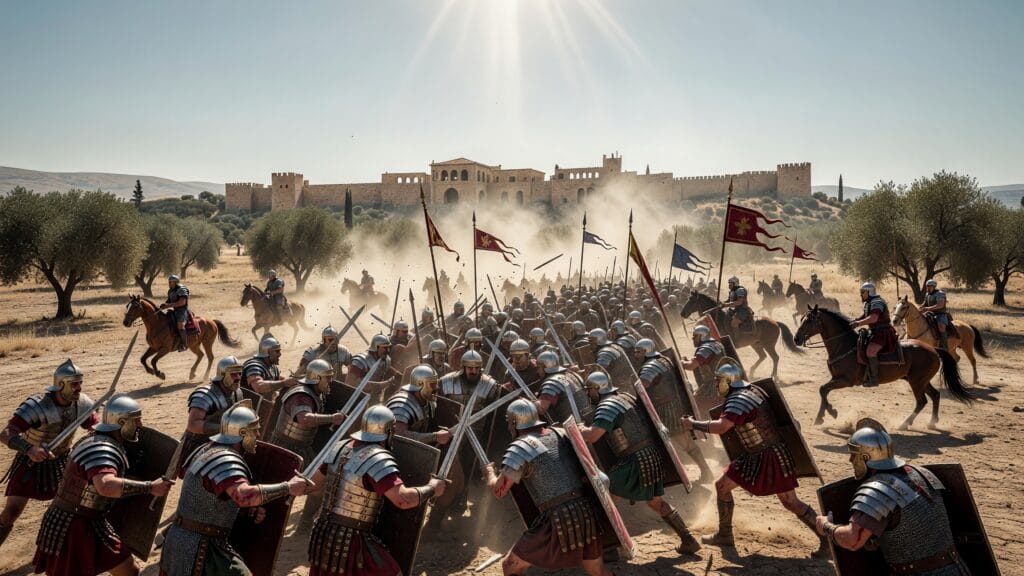
- The Morning of June 8, 218: Lines on the Plain
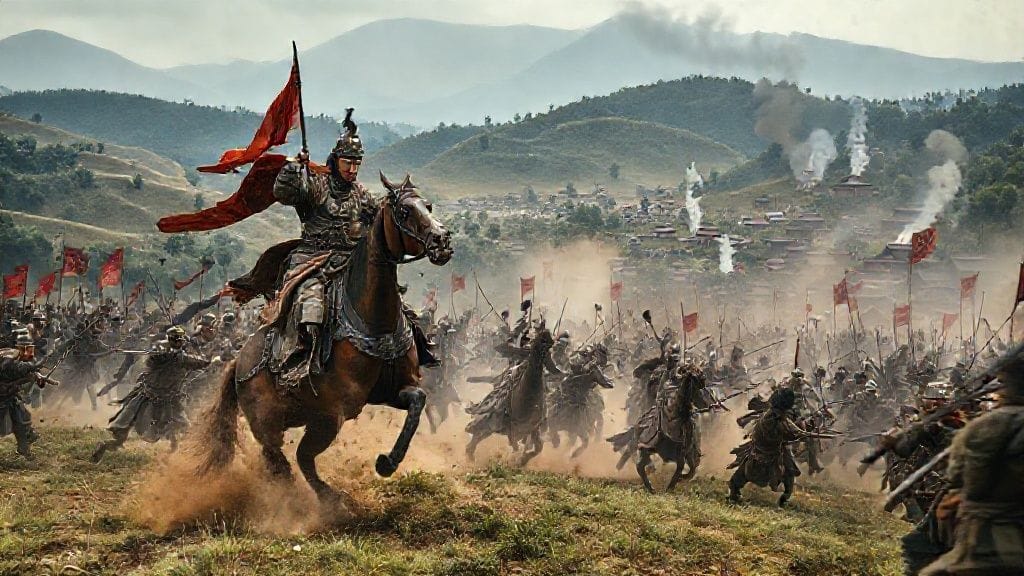
- The Battle Unfolds: Cavalry Charges and Feigned Retreats
- Collapse and Pursuit: Macrinus on the Run
- Seizing the City: Antioch After the Battle
- Power and Religion: Julia Maesa and the Emesene Sun
- Costs and Consequences Across the Empire
- How We Know: Sources, Silences, and Debate
- Conclusion
- FAQs
- External Resource
- Internal Link
Article Summary: On June 8, 218, near Antioch, a teenage priest backed by a powerful grandmother toppled a sitting emperor. This feature reconstructs the battle of antioch 218 and the weeks that produced it. We trace Caracalla’s assassination, Macrinus’s uneasy rule, and Julia Maesa’s bold counterstroke. Tactical details meet political consequences. Sources like Cassius Dio and Herodian guide, but also caution us. The victory remade the imperial court, reshaped religious imagery, and exposed how fragile Roman power could be.
Why keep reading: A single day outside Antioch changed the Roman throne, binding ritual, money, and military honor to a teenager’s fate. The tension between an equestrian emperor and a resurgent dynasty reveals how armies, ideas, and rumor could cut deeper than any sword.
At a glance:
- Event: Battle near Antioch that ended Macrinus’s reign and raised Elagabalus to imperial power
- Date: June 8, 218 (ancient sources agree on the day, though some details of the aftermath vary)
- Place: Plains outside Antioch in Roman Syria, close to the Orontes corridor
- Main figures: Emperor Macrinus; Marcus Aurelius Antoninus (Elagabalus); Julia Maesa; Gannys; Legio III Gallica
- Why it mattered: Restored the Severan line, reshaped imperial ritual, and demonstrated the decisive political power of legions and provincial elites
01 – Rome on the Brink: Caracalla’s Assassination and the Eastern Legions
Everything began with a roadside killing in April 217. Caracalla was murdered near Carrhae, cut down while relieving himself, and his praetorian prefect Macrinus stepped into a vacuum he helped create. The empire he inherited was weary from war, haunted by debts, and anchored by legions stretched thin along the eastern frontier.
The eastern troops had marched and bled for years under Severan banners, expecting pay, honor, and advancement. Caracalla was gone, but his dynasty’s prestige still moved men. The new equestrian emperor lacked a noble name and, crucially, the sentimental loyalties that bound soldiers to Severan memory.
It is easy to forget how fragile this world still was. Messages traveled by relay and rumor; frontier officers balanced fear and ambition. Into this atmosphere of uncertainty, the battle of antioch 218 would later pour like a storm, gathering the resentments and hopes of provinces that had learned to read politics through legions.
02 – The Making of Elagabalus: Emesa, Priesthood, and Propaganda
In Emesa, a city bound to Rome but faithful to its own gods, a young high priest tended a black sacred stone. Varius Avitus Bassianus—soon styled Marcus Aurelius Antoninus, known to us as Elagabalus—was barely a teenager. Yet under the sacred canopy of the sun’s cult, he learned how ceremony confers authority.
His grandmother, Julia Maesa, read the wind better than any augur. Sister of Julia Domna and kin to Caracalla, she turned dynastic nostalgia into a political instrument. By paying arrears and promising Severan restoration, she won the ear and heart of Legio III Gallica, long stationed in Syria and proud of its record.
Legio III hailed the boy emperor in spring 218 at Raphanea, acclaiming him under Severan names to frame legitimacy. Coins would later amplify the claim, but in these first days, whispers worked better than die-struck portraits. Soldiers believed, or wanted to believe, that Caracalla’s blood still flowed in the purple.
03 – Macrinus the New Emperor: Governing by Compromise
Macrinus played for time. He made a costly peace with Parthia after the bruising struggle at Nisibis, trading treasure and prestige for stability. He then tried to rein in military spending, trimming bonuses and reorganizing benefits. For war-weary provincials, the peace looked prudent; for career soldiers, it felt like betrayal.
His court at Antioch projected order—edicts, auditors, and couriers—but authority without affection is brittle. He had the signet and the guard, yet lacked the myth that sustained Severan rule. To bridge that gap, he alternated threats with conciliation, hoping discontent would ebb before a Severan revival could gather shape.
04 – March to Antioch: Forces, Geography, and Stakes
The road to Antioch followed older warpaths. The Orontes valley offered space for supply wagons and room for cavalry to move, while the city’s walls promised rich barracks and easier logistics. Macrinus gathered his field forces and praetorians, anticipating a quick punitive strike against a provincial flare-up before it spread.
Opposite him, the Severan coalition mustered veterans, auxiliaries, and local levies under Gannys, an unlikely field commander raised from the household. It was a gamble. But Maesa’s money and the emblem of the sun turned raw recruits into men with a cause. The rebel army marched toward history and high risk.
By early June the two sides probed each other’s screens on the plains not far from Antioch. Dust hung over irrigation ditches and tracks. Scouts counted tents and horses, while couriers rode hard to promise amnesty or vengeance. The stakes were the throne, soldierly privilege, and the meaning of Severan legitimacy.
Mini timeline:
- April 217: Caracalla assassinated near Carrhae; Macrinus becomes emperor.
- May 218: Julia Maesa secures Legio III Gallica; Elagabalus acclaimed at Raphanea.
- June 8, 218: Battle fought near Antioch; Macrinus defeated.
- Late 218–219: Macrinus and Diadumenian killed; Elagabalus consolidates, later enters Rome.
05 – Opening Gambits: Skirmishes, Spies, and Letters
Before spears leveled, pens went to work. Macrinus sent messages offering titles and wealth to those who would abandon the Severan boy, testing loyalty with calculated mercy. He also tried to discredit the claim of blood, circulating letters that mocked the rumor of Caracalla’s paternity as crafted theater.
The rebels countered with oaths and coin, swearing Severan continuity and hinting at restored privileges. Light skirmishes between cavalry outposts marked the days, as each side tried to fix the other and learn its rhythm. Small victories on the perimeter fed campfire talk, sharpening confidence or anxiety depending on the banner.
When a few detachments from Macrinus’s forces drifted toward the Severan lines, the signal was unmistakable. Discipline still held in the imperial camp, but it held under pressure. The emperor’s best hope was to fight swiftly, before defections turned trickles into streams. He ordered preparations for a pitched battle.
06 – The Morning of June 8, 218: Lines on the Plain
Morning light revealed two armies arrayed on open ground outside Antioch. Macrinus placed his praetorians as a hard central core, with cavalry and Moorish light troops on the wings. His archers and spearmen formed layered ranks, hoping to break any reckless charge with disciplined volleys and a steady push.
Across the field, Gannys aligned veterans near the center, anchoring them with cohorts of Legio III Gallica. On the flanks he placed cavalry raised in the region, confident they could harry and withdraw against better-equipped riders. Behind them, Julia Maesa and her household watched from a guarded position, visible to urge courage.
The boy emperor did not lead the line; he stood as symbol and future. Standards rose, horns sounded, and the ground trembled beneath marching boots. Contemporary sources suggest the initial advantage leaned to Macrinus, but carefully describe a fight that pivoted not only on arms, but on morale and meaning.
07 – The Battle Unfolds: Cavalry Charges and Feigned Retreats
According to Herodian, Macrinus’s praetorians pressed hard, pushing back the Severan center in the early exchanges. Gannys, derided as inexperienced, surprised opponents by coordinating a stubborn defense, rotating lines as the pressure built. On the flanks, Syrian horsemen rode in, loosed, withdrew, and rode again, grinding down imperial patience.
At a crucial moment, Legio III Gallica advanced under its eagle, shouting Severan names. Whether the rebels staged a feigned retreat on one wing or simply absorbed and countered, the effect was the same: imperial ranks lost cohesion. The battlefield rhythm shifted, and with it the balance of courage and fear.
Here the battle of antioch 218 became a verdict on loyalty. Once officers sensed hesitation in the imperial line, some pushed forward to prove resolve; others held back, worried about exposure if the tide turned. Gannys seized the moment, ordering a general surge that drove wedges into the loosening imperial front.
08 – Collapse and Pursuit: Macrinus on the Run
When the imperial center cracked, panic rode faster than messengers. Macrinus attempted to rally, but his cry could not stitch a broken line. As the Severan forces pressed, imperial units fell back toward the road, then ran. The emperor fled the field, trading the dignity of command for the chance of survival.
Ancient accounts, while differing in detail, agree that Macrinus fled northward in disguise, shaving his beard to avoid recognition. He sought either to regroup or reach safety across the straits, but was captured near Chalcedon according to several versions, then executed. The emperor’s son, Diadumenian, was intercepted near Zeugma on the Euphrates.
The rout carried a cruel lesson. An emperor’s authority could vanish between one dust cloud and the next. The soldiers who had kept their ranks to the final push now claimed the right to name their reward. The victory solved one problem and created another: maintaining loyalty amid triumph’s expensive expectations.
09 – Seizing the City: Antioch After the Battle
The conquerors entered Antioch to acclamations and bargaining. Elagabalus, styled Marcus Aurelius Antoninus, received salutes; oaths were renewed; arrears were promised. Markets reopened, but the city also became a stage where the new regime demonstrated its generosity to soldiers and its firmness toward suspected loyalists of Macrinus’s court.
Coins soon proclaimed victory and continuity, bearing titles that attached the teenager to Severan memory. Festivals and distributions signaled a restored order, even as courtiers argued about priority and precedent. The name of Julia Maesa traveled quickly through corridors, whispered with respect and calculation; everyone understood power moved through her hands.
For the ordinary people of Antioch, a day of shouts gave way to weeks of adjustments. Prices shifted as military pay chests arrived, and petitioners crowded halls seeking legal redress or confirmation of privileges. The battle of antioch 218 turned from spectacle to administration, a test of whether symbolic victory could become stable rule.
10 – Power and Religion: Julia Maesa and the Emesene Sun
Julia Maesa moved with assured purpose, placing relatives and loyalists in key posts. Her daughter Julia Soaemias guided court politics around the adolescent emperor, while allies like Comazon rose rapidly. This family-centered governance annoyed Roman traditionalists, but it also provided a backbone of trust in volatile months after victory.
Religion furnished language for rule. The Emesene sun, embodied in a sacred stone, stood behind Elagabalus’s identity. In Syria that symbolism read as prestige and ancestral piety. When projected toward Rome the next year, it would collide with expectations about Jupiter’s primacy and the rituals that bound emperor and city together.
Modern historians debate degree and intent, but sources agree Elagabalus elevated his cult within imperial imagery. That began in the East, where triumph merged with worship. The language of favor and victory, long standard on Roman coinage, now bent toward a specific god. It thrilled followers and unsettled senators watching from afar.
11 – Costs and Consequences Across the Empire
Victory demanded payment. To secure the armies, Elagabalus restored or enhanced benefits trimmed under Macrinus. Soldiers celebrated, but treasurers counted anxiously. Provincial tax systems creaked under the strain, and the mint worked to keep up with promises stamped in the emperor’s new titles and smiling personifications of Peace and Victory.
The Senate, long sidelined under the Severans, confirmed what the legions had already pronounced. Senatus consulta framed the regime as legitimate, but real power flowed from troops and family networks. Some governors were replaced; others swore loyalty quickly, preferring continuity to another round of bloodletting in far-off councils and camps.
Social consequences rippled through identity and prejudice. A Syrian court, a teenage emperor, and a foreign-looking cult sharpened anxieties in Italy and Gaul. Yet in the East, civic elites found doors opening. Contracts, priesthoods, and honorary posts rewarded cooperation. The battle of antioch 218 thus redrew not borders, but boundaries of influence.
Immediate consequence:
Macrinus’s regime collapsed; Elagabalus was hailed as Augustus. Military pay and honors were restored, and Antioch became a confident capital-in-waiting for an emperor preparing to move west.
Long-term consequence:
Religious and cultural tensions followed Elagabalus to Rome, straining ties with the Senate and reshaping court ritual. The Severan house reasserted itself, but at the price of dependence on eastern legions and family politics.
12 – How We Know: Sources, Silences, and Debate
The documentary record is fragmentary. Cassius Dio offers a senatorial lens colored by disdain for court extravagance and eastern customs. Herodian supplies vivid narrative but wrote with an eye to moral lessons. The Historia Augusta, compiled later, mixes details with invention. Careful readers triangulate, testing stories against coins, inscriptions, and papyri.
Numismatic evidence from Antioch and other mints confirms the speed of acclamation and the restoration of Severan names. Provincial inscriptions record dedications to the victorious emperor and petitions for favor. Egyptian papyri reflect regnal dating shifts in mid-218, pinning administrative changes to the very weeks that followed the battle.
Modern historians remain cautious because the surviving evidence points toward court perspectives. We lack unit rolls and detailed casualty lists. Even the precise sequence of the rout and the routes of flight leave room for debate. Yet the broad arc stands firm: a field decision near Antioch transformed the shape and mood of Roman power.
13 – Conclusion
The field outside Antioch, on June 8, 218, settled more than a personal rivalry. It resolved a crisis of legitimacy by fusing dynastic memory, sacred symbolism, and military expectation. In the battle of antioch 218, steel mattered, but so did story: soldiers believed they were restoring a rightful line, and fought accordingly.
That belief carried Elagabalus from Syrian plains to Roman palaces, trailing both loyalty and unease. The victory proved that Rome’s empire could be remade on provincial ground, under banners unfamiliar to the Capitol. Its legacy endured beyond the young emperor’s short, turbulent reign—an enduring reminder that power rests where armies, money, and meaning meet.
14 – FAQs
- When did the battle occur?
The battle was fought on June 8, 218, during a volatile moment after Caracalla’s assassination and Macrinus’s brief, contested reign. - Where was it fought?
The engagement took place on open ground near Antioch in Roman Syria, leveraging the Orontes corridor’s flat approaches and supply routes. - Who were the main figures?
Emperor Macrinus led the imperial army, while the teenage Elagabalus—backed by Julia Maesa—fronted the Severan coalition. Gannys, raised from Maesa’s household, directed rebel tactics. Legio III Gallica formed the rebel backbone. - What caused the conflict?
Competing claims to legitimacy after Caracalla’s assassination, combined with Macrinus’s unpopular cuts to military benefits, drove eastern legions toward a Severan restoration centered on Elagabalus. - What were the consequences?
Macrinus’s regime collapsed; he and his son Diadumenian were killed. Elagabalus secured the throne, restored military privileges, and introduced religious imagery from Emesa into imperial iconography, altering court politics and ritual. - Why is the event remembered?
The battle of antioch 218 is remembered for restoring the Severan house, demonstrating the decisive power of provincial legions, and prefiguring tensions between eastern religious traditions and Roman senatorial expectations.
15 – External Resource
16 – Internal Link
Other Resources
- Encyclopaedia Britannica – general search for the exact subject
- Google Scholar – academic search for the exact subject
- Internet Archive – digital library search for the exact subject
Sources and References
-
Cassius Dio, Roman History, Book 79 (or 80 in some editions), esp. 79.30–39.
Note: Primary narrative source for the revolt of Elagabalus (Varius Avitus Bassianus), the movements of Macrinus, and the description of the decisive engagement near Antioch in June 218, including troop morale, desertions, and the emperor’s flight. -
Herodian, History of the Roman Empire since the Death of Marcus Aurelius, Book 5, chapters 3–5.
Note: Provides an additional contemporary account of the civil war between Macrinus and Elagabalus, the role of the Syrian legions, and the political background in Antioch and the East leading up to the battle. -
Historia Augusta, “Antoninus Heliogabalus.”
Note: Later, problematic but still useful source for anecdotal details and later Roman perceptions of Elagabalus’ rise to power after the victory near Antioch; used cautiously and corroborated against more reliable sources. -
Fergus Millar, The Roman Near East, 31 BC – AD 337. Cambridge: Harvard University Press, 1993.
Note: Contextualizes Antioch’s role as an imperial and military center in the eastern provinces, explaining why the city and surrounding region were strategically crucial for the conflict between Macrinus and Elagabalus. -
Michael Grant, The Severans: The Changed Roman Empire. London: Routledge, 1996.
Note: Modern overview of the Severan dynasty, including detailed discussion of Macrinus’ short reign, the Syrian legions’ discontent, the Elagabalus uprising, and the political consequences of the battle fought near Antioch in 218. -
Pat Southern, The Roman Empire from Severus to Constantine. London: Routledge, 2001.
Note: Provides scholarly analysis of the transition from Caracalla to Macrinus and then to Elagabalus, including military reforms, fiscal issues, and how these factors contributed to the army’s decision to support the usurper and the outcome of the battle. -
Clifford Ando (ed.), Imperial Rome AD 193–284: The Critical Century. Edinburgh: Edinburgh University Press, 2012.
Note: Offers broader political and military background for the “soldier-emperor” period, situating the battle near Antioch within the recurring pattern of military revolts, contested accessions, and the centrality of frontier armies in imperial politics. -
“Macrinus” and “Elagabalus,” in Oxford Classical Dictionary, online edition, Oxford University Press.
Note: Concise, peer‑reviewed entries summarizing the careers of Macrinus and Elagabalus, clarifying chronology (including the 8 June 218 date), prosopographical details, and the main sequence of events culminating in the battle near Antioch.